Get Full Government Meeting Transcripts, Videos, & Alerts Forever!
Get email alerts on the Uocava Policy topic
No spam. Unsubscribe anytime.
Experts urge Montana to tighten UOCAVA rules: require citizenship proof, separate military/non‑military rules, limit electronic ballot return
Summary
Heather Honey briefed the committee on the Uniformed and Overseas Citizens Absentee Voting Act (UOCAVA) and urged statutory changes including documentary proof of citizenship for overseas applicants, separation of military and non‑military rules, clearer deadlines and limiting electronic ballot return except where no alternative exists.
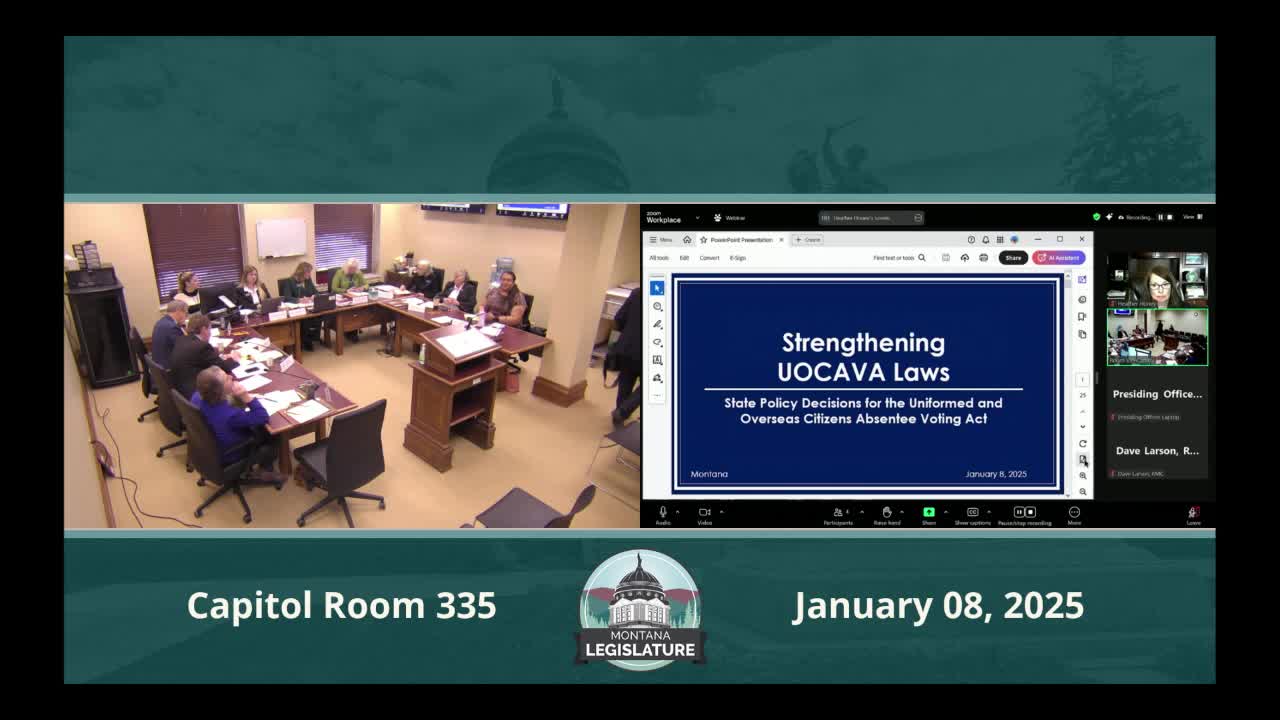
Heather Honey, an expert on overseas absentee voting, told the Senate State Administration and Veterans Affairs Committee that UOCAVA (the Uniformed and Overseas Citizens Absentee Voting Act) obligates states to accept the federal postcard application but leaves the states discretion on many policy details such as residency rules, identification requirements and ballot return methods.
Honey explained that the MOVE Act amendment requires states to transmit ballots to overseas applicants 45 days before an election if the application arrives in time, and that UOCAVA covers both military voters and a growing number of non‑military U.S. citizens living abroad. She said non‑military applicants have comprised about 65% of UOCAVA ballots in the 2022 data and that many overseas applicants request electronic transmission of ballots.
Honey recommended several legislative options Montana could adopt to tighten safeguards: separate statutory processes and deadlines for military and non‑military overseas voters; require documentary proof of U.S. citizenship for UOCAVA applicants (for example, a U.S. passport or certificate of citizenship); require verification of prior in‑state residency for those who never resided in the U.S.; require proof of current overseas status for permanent or indefinite overseas applicants; use provisional absentee ballots when verification is pending; and limit electronic return of voted ballots except where a voter has no practicable alternative, citing multi‑agency guidance from the EAC, FBI and CISA that electronically returned ballots pose higher security risk.
Committee members asked procedural and evidence questions. Senator Phelan asked how electronically transmitted ballots are handled; Honey described the common practice of recreating or duplicating emailed/printed UOCAVA ballots onto an official tabulatable ballot under bipartisan controls. Senator Vance and others requested copies of Honey’s slides; staff agreed to add the presentation to the committee record and circulate it to members.
Honey offered to provide model statutory language and examples from states with elements she described as useful (Arizona, Ohio and Georgia). She also suggested that training for local election officials on UOCAVA rules and procedures would improve consistent application of requirements across counties.
The committee took no formal vote but directed staff to collect the presenter’s materials for the record and consider Honey’s suggested statutory clarifications as part of the session’s bill drafting process.