Get Full Government Meeting Transcripts, Videos, & Alerts Forever!
Get email alerts on the Legislative Finance topic
No spam. Unsubscribe anytime.
Appropriations committee advances $19.1 million "FEED" bill to fund 2025 legislative session
Summary
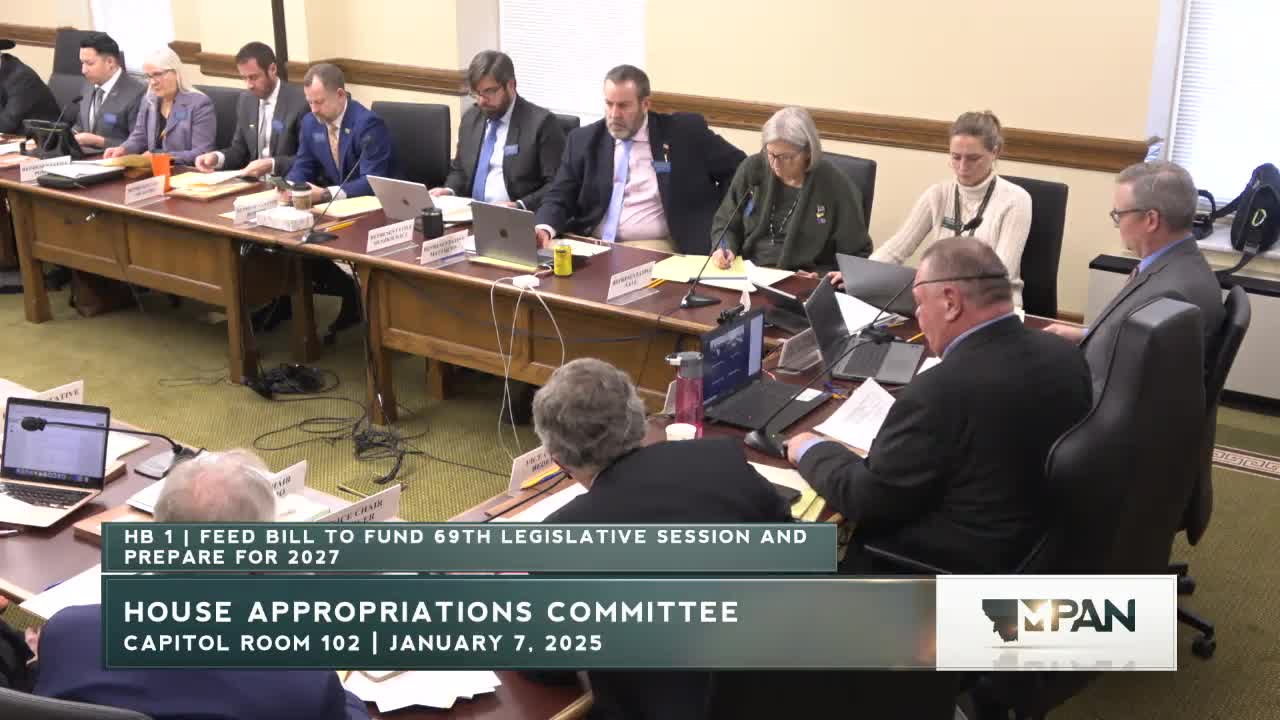
Representative Lou Jones, chair of the House Appropriations Committee, opened the hearing on House Bill 1, the annual FEED bill, which staff described as roughly $19.1 million to fund legislative salaries, staff and session operations and to provide startup funding for the next session.
Representative Lou Jones, chair of the House Appropriations Committee, opened the committee’s hearing on House Bill 1 — the annual “FEED” bill that funds the legislature’s salaries, per diems, staff and operational costs — and deferred detailed explanation to legislative financial staff.
"House Bill 1 is known as the FEED bill," Jones said when he introduced the measure, saying the bill pays salaries, per diems and session operations and that the chamber is currently running on the prior session’s appropriation.
Legislative branch financial manager Angie Carter provided the committee’s detailed overview. She told members the bill request covers the 2025 session and start-up funding for the 2027 session and that it is sized to allow the legislature and its staff to continue operations. "The feed bill is $19,000,000 for the 25 session and then the start up for the 27 session," Carter said. She outlined line items that the bill funds, including legislator salaries, per diems, House and Senate staff, bill printing and publication, session system support contracts, some additional staff positions (an audio‑visual engineer, half of a research analyst and half an attorney), and a line item for outside legal work tied to a recent court order.
Committee members asked for further detail on several points. Members asked for a written spreadsheet of the bill’s line‑item breakdown; Carter said she would provide that. Members also pressed staff about a proposed $125,000 line item for outside counsel related to a court order; Executive Director Jerry Howe and Chief Legal Counsel Todd Evertz explained the amount is an estimate to cover litigation and the implementation of a district court order relating to legislative privilege and the review of so‑called "junk files," and that the estimate reflects potential appeals.
Several members sought clarification on what in the bill was "business as usual" versus new or one‑time increases; Carter and Director Howe said some increases reflect ongoing costs (higher printing and session support contracts, federal per diem increases and staff pay matrix adjustments previously approved by Legislative Council) and some new or changed items reflect added audiovisual and remote‑participation technology and startup funding for the next session. Carter also said the bill includes funding tied to House Bill 13’s proposed statutory pay changes for legislators; if House Bill 13 does not ultimately take effect as written, leadership would consider reverting unspent funds.
After questions and a short discussion about timing and informational materials, the vice chair moved executive action. The committee approved the motion by voice vote; the chair declared the motion passed unanimously and said the FEED bill will move to the floor. The committee asked staff to prepare the detailed spreadsheet for floor consideration.
Why it matters: House Bill 1 provides the cashflow that lets the legislature and its staff operate. Without it, staff payroll and session operations would be at risk. The bill also includes funding tied to a pending legal matter and startup money for the next legislative session.
Ending: Committee staff said they will circulate the detailed line‑item spreadsheet before floor action and that members who want further briefings should contact fiscal staff.