Get Full Government Meeting Transcripts, Videos, & Alerts Forever!
Get email alerts on the Committee Organization And Procedures topic
No spam. Unsubscribe anytime.
Montana Senate committee adopts proxy and witness rules, refers three non‑appointment bills back to Senate president
Summary
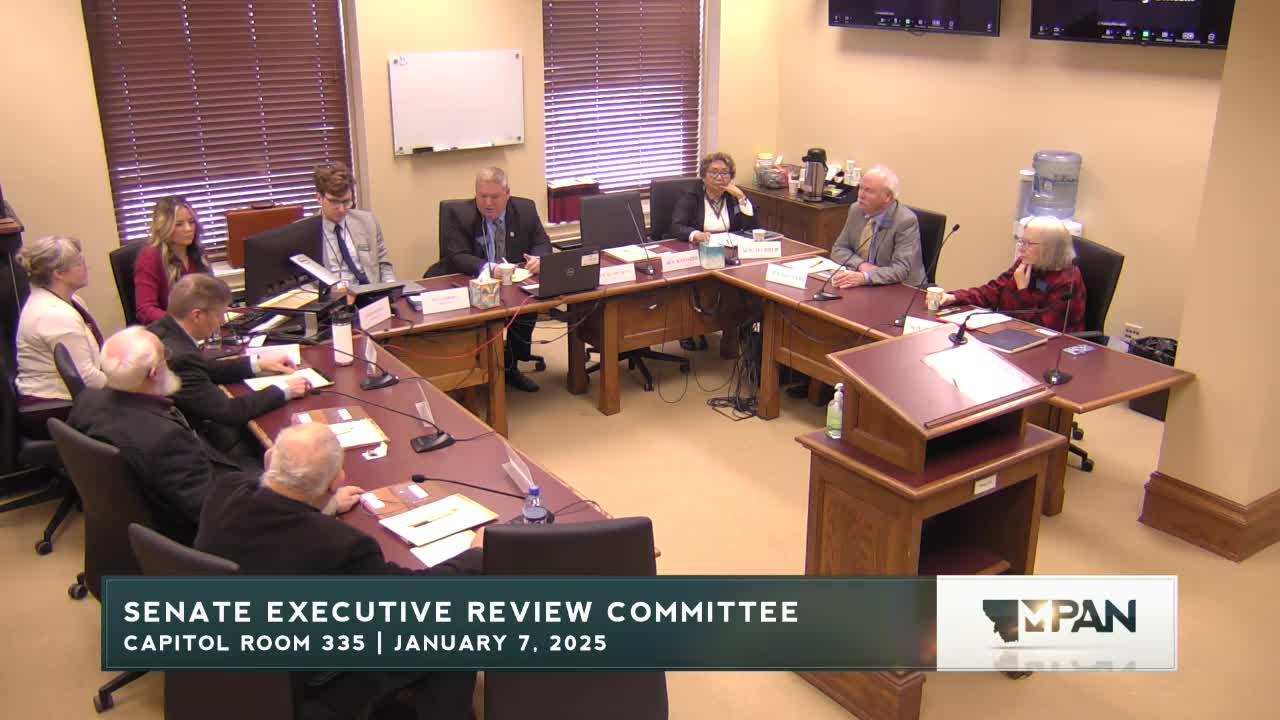
At an organizational meeting Jan. 7, a Montana State Senate committee led by Chair Jason Ellsworth agreed to allow proxy voting handled by vice chairs, limited informational‑witness remarks, and voted unanimously to return three non‑appointment agency bills to the Senate president for reassignment.
Chair Jason Ellsworth, of Senate District 43, opened the Montana State Senate committee’s Jan. 7 organizational meeting and laid out the panel’s primary role: reviewing gubernatorial confirmations and conducting interviews before sending recommendations to the full Senate.
“Today is just organizational,” Chair Jason Ellsworth said. “We could, you know, do an adverse committee report on somebody. We don't get to decide if they go forward or not per se. We get to do the process of the interview and ask the questions and get testimony. But at the end of the day, they go in front of the entire Senate. So ours is recommendations.”
Committee members agreed on three procedural points the chair flagged as priorities: establishing proxy voting procedures, limiting informational‑witness remarks to identification unless members request testimony, and operating the committee “on call” with notice consistent with open‑meeting requirements.
The committee decided proxies are permissible and recommended that each side designate a vice chair to hold and cast proxy votes on behalf of absent members. “Typically, how we've handled them, is from the majority, would be the vice chair, and they vote those proxies. And then from our other vice chair on the other side of the aisle, they would typically vote those proxies,” Ellsworth said.
On informational witnesses, Joe Carroll, an attorney with the Legislative Services Division, described the committee’s options: allow informational witnesses only to state their name and affiliation and be available later, or permit them to provide testimony before questioning. The committee chose the more limited approach: witnesses will introduce themselves, state expertise and availability, and be called for testimony only if a member requests it. Senator Russ Temple said he had “seen work best, in my opinion, is they introduce themselves and what this what their subject part might be and then be available for information down the road.”
Ellsworth also reiterated scheduling expectations. The committee will meet “on call” and follow open‑meeting timing: “We have to follow open meeting laws, which is a 3 days notice,” he said. Members were told the chair will set meeting times as needed and work with staff to coordinate around members’ other committee obligations.
The committee took one formal action. Ellsworth moved — and the committee agreed by a unanimous voice vote — to refer three non‑appointment bills that had been assigned to the committee back to the Senate president so they could be reassigned. Committee staff told members the three were short, agency bills requested by the Department of Administration; specific bill numbers and full titles were not stated at the meeting. The committee performed a voice vote and recorded the motion as carried.
The meeting concluded after a brief administrative discussion about contact information and voluntary contributions to buy snacks for long hearings. Committee members and staff were reminded to submit contact numbers to the committee secretary and to provide signed proxy forms to vice chairs when needed.
No final confirmation hearings or substantive nominee reviews occurred at the session; Ellsworth said such hearings will be scheduled after confirmations are formally assigned to the committee.