Get Full Government Meeting Transcripts, Videos, & Alerts Forever!
Get email alerts on the Property Tax Exemptions topic
No spam. Unsubscribe anytime.
Bill would require reporting when tax‑exempt entities lease property for private business use
Summary
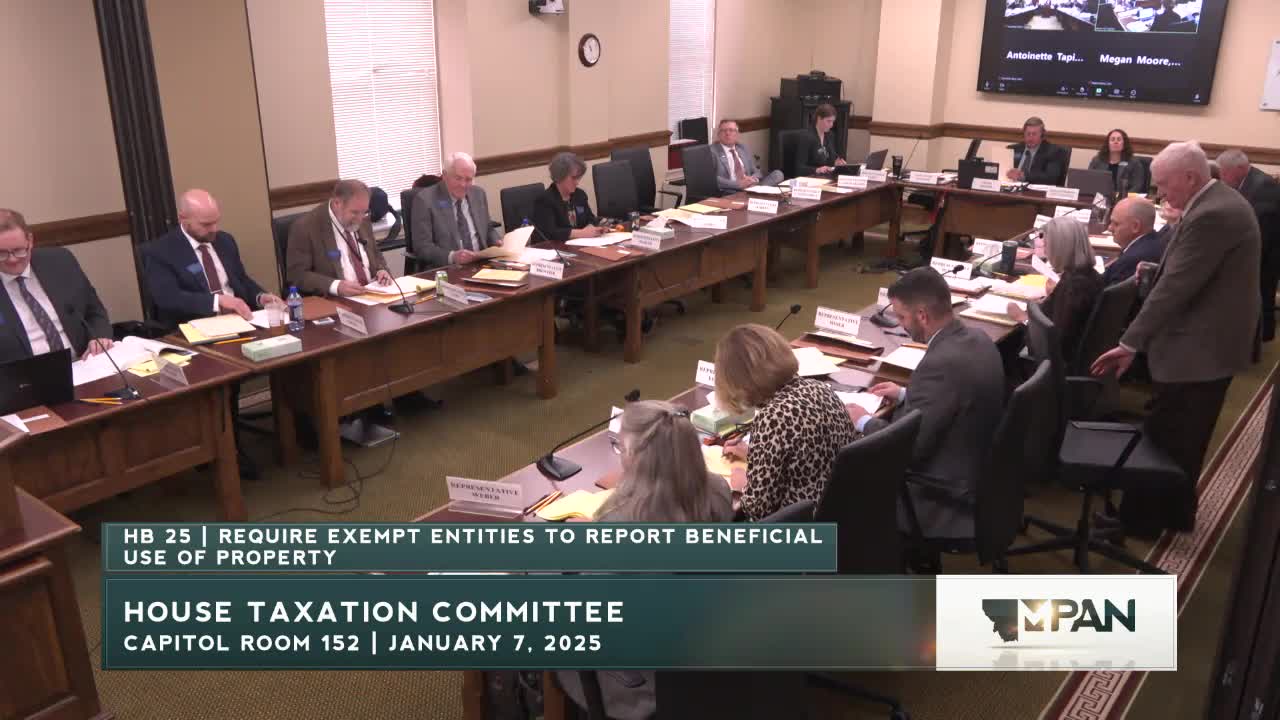
House Bill 25 would follow a Legislative Audit Division recommendation and require exempt property owners to report when property is leased or used by nonexempt businesses; supporters say it improves transparency, opponents warned it could imperil minor‑league baseball and other activities if applied broadly.
Representative Sherry Essman opened the hearing on House Bill 25, saying the bill “fulfills a recommendation from the Legislative Audit Division” to require reporting when tax‑exempt property is leased to nonexempt organizations for beneficial or exclusive use.
David Singer, a management and program analyst with the Legislative Audit Division, said the bill implements recommendation 5 from a May 2023 audit of real property tax exemptions that directed better reporting and information collection to aid administration and policy decisions.
Bob Story of the Montana Taxpayers Association supported the concept. “Businesses that are operating out of a non profit's property and leasing it are competing against businesses that own property,” he said, and reporting would identify where that occurs.
Opponents included Ella Smith, representing the City of Missoula, who said an earlier effort to require similar reporting had been abandoned because of consequences for minor‑league baseball and other community activities. Smith warned the bill “would cause most, if not all, of Montana's minor league baseball teams to cease to exist” if applied to stadium leases and urged the committee to table the bill.
Robin Rood of the Department of Revenue said the statute that authorizes the beneficial use tax applies to leases that are “industrial, trade, or other business purpose,” and that the tax typically applies only to the leased portion (for example, a coffee shop’s square footage within a larger publicly owned building). Ms. Rood and Mr. Singer said the bill as drafted focuses on information collection; implementation details and statutory cross‑references may be adjusted in forthcoming drafting amendments.
Representative Essman said she planned to work with DOR and the audit division to produce clarifying amendments and asked the committee to consider the bill with those changes. The committee did not take executive action during the hearing.