Get Full Government Meeting Transcripts, Videos, & Alerts Forever!
Get email alerts on the Local Property Tax Reform topic
No spam. Unsubscribe anytime.
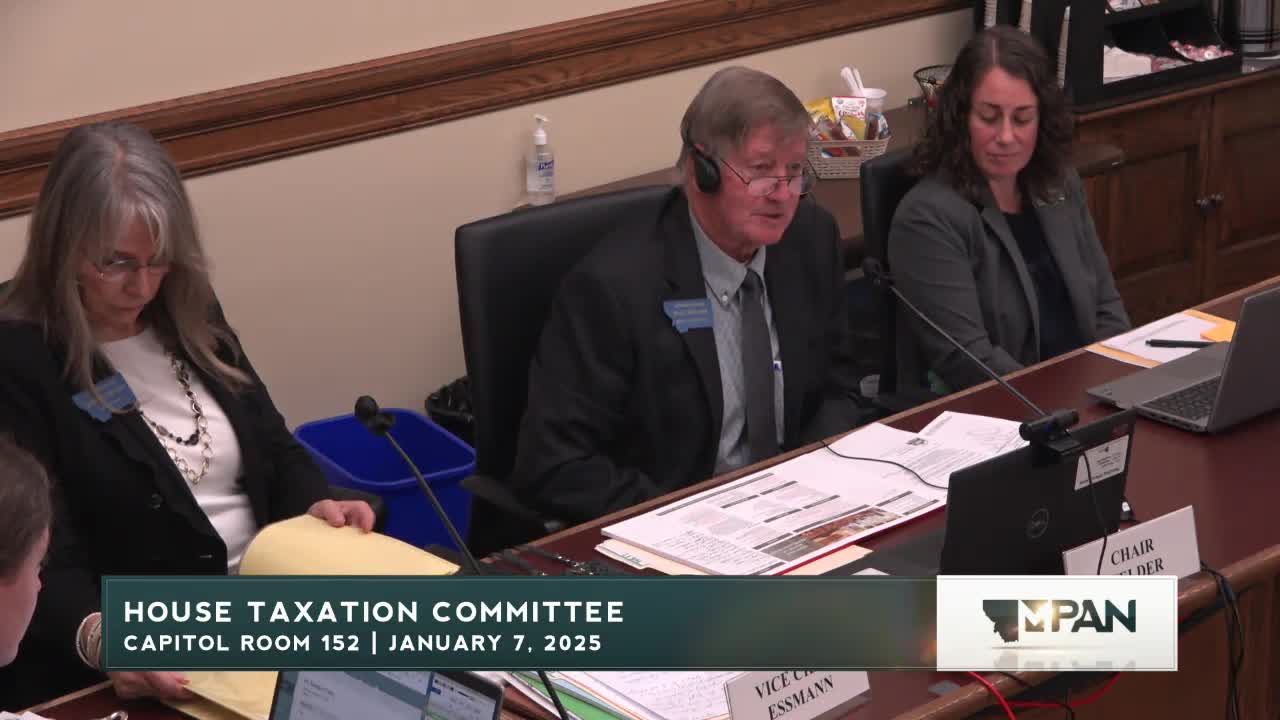
Proposal to require voter-approved levies in dollars, not mills, draws split testimony
Summary
House Bill 20 would require local governments to put voter-approved levies as dollar amounts rather than mill levies; sponsors and taxpayer groups argued it increases predictability, while cities and counties warned it could reduce flexibility for ongoing operational costs and hamper services without inflation adjustments.
Representative Larry Brewster opened the hearing on House Bill 20 and described the measure as a change to how local governments present voter‑approved levies. “It allows them to vote a dollar amount and then they level the mills to reach that dollar amount,” Brewster said, and he described a sponsor amendment that would remove school districts from the bill’s scope.
Bob Story, executive director of the Montana Taxpayers Association, testified in support and described the policy goal: moving voters to approve a fixed dollar amount so local governments do not “profit from growth in value due to reappraisals and inflation.” Story said that if voters approve a dollar amount, “as the taxable values go up, mills have to go down, collect the same number of dollars.” He said the bill was intended to limit local governments from benefiting automatically from rapid valuation growth.
Kelli Lynch, executive director of the Montana League of Cities and Towns, opposed the bill in its current form and urged the committee to preserve local flexibility for operational levies. Lynch explained that local governments “rely entirely on property taxes” and that operational needs — hiring and retaining police and fire personnel, operating treatment plants, and other continuing costs — typically track through mills. Lynch proposed an amendment she supports that would allow local governments to ask voters for full inflation (instead of being limited to half the rate of inflation under current law) so that operational levies could cover personnel and ongoing costs.
Other local government witnesses, including Jennifer Hensley (representing county concerns in Missoula) and Danny Hess (representing Bozeman), said dollar levies can erode long‑term service capacity because fixed dollar amounts do not automatically rise with the cost of operations or new users. Doug Reisig of the Montana Quality Education Coalition thanked the sponsor for the amendment removing schools from the bill’s scope; schools operate under different funding statutes and were a recurring concern among witnesses.
Proponents such as the Montana Association of Realtors said voters should “understand what they're voting for,” while several cities and counties asked the committee to approve an amendment allowing full inflation adjustments for operational levies so that public safety and maintenance needs could be sustained.
Committee members asked technical questions about how mill levies and dollar levies function, and witnesses explained that bonding questions remain dollar based because bond financing requires a fixed repayment stream. Representative Brewster said he expects amendments before executive action and asked members to consider the balance between predictability for taxpayers and operational flexibility for local governments. The committee did not take final action during the hearing.