Get Full Government Meeting Transcripts, Videos, & Alerts Forever!
Get email alerts on the Gambling Regulation topic
No spam. Unsubscribe anytime.
Gambling control division warns of offshore online casinos, reports $83.7 million in FY24 machine tax revenue
Summary
Jason Johnson, administrator of Montana’s Gambling Control Division, briefed the House Business and Labor Committee on the division’s responsibilities and identified offshore online gambling platforms as a priority enforcement and legislative target; he also cited FY24 video‑machine tax revenues of about $83.7 million.
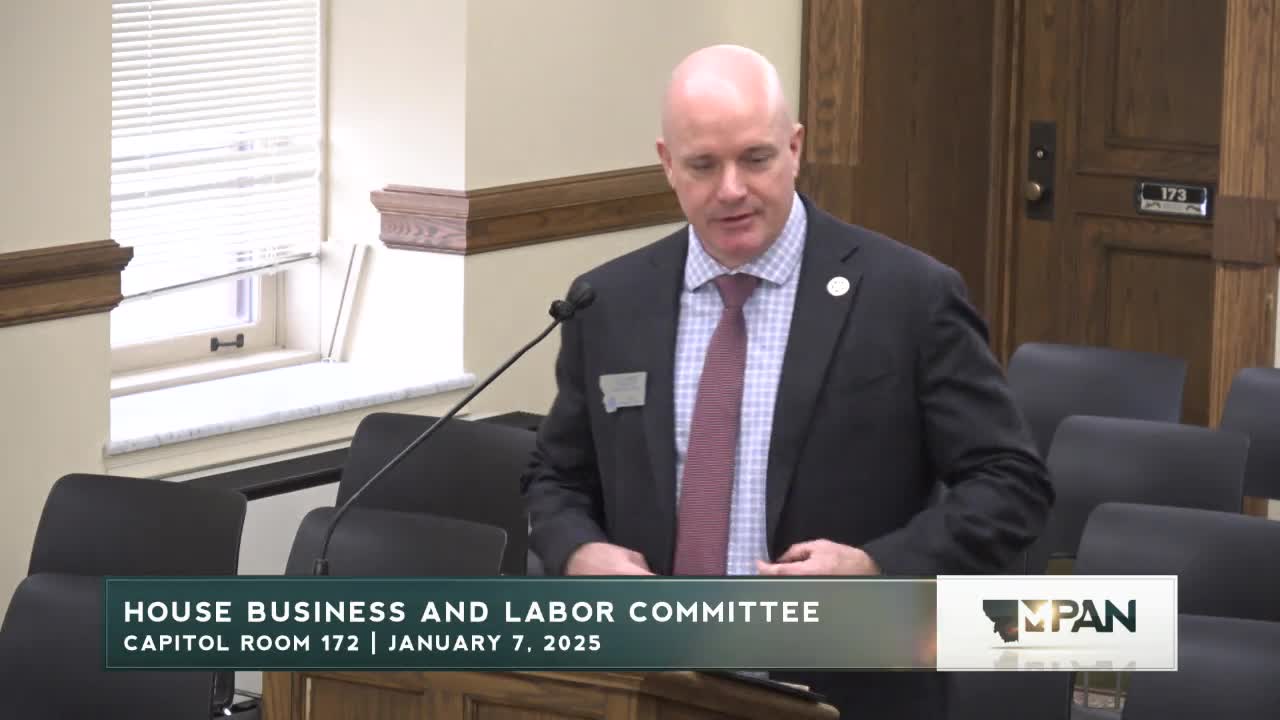
Jason Johnson, administrator of the Montana Gambling Control Division, told the House Business and Labor Committee Wednesday that video‑gaming machines and other regulated gambling forms generate significant tax revenue and that the division is prioritizing actions against unregulated offshore online gambling platforms.
Johnson noted the long history of centralized gambling regulation in Montana and cited the tax yield from regulated gaming devices: “In fiscal year 24, that amount came to $83,700,000,” he said, referring to the statutory 15% tax on gaming machines. He described the division’s responsibilities — licensing, technical testing of machines in a Helena lab, compliance inspections, auditing and criminal‑background checks — and said the office operates with roughly 34 full‑time equivalent staff distributed across regional offices.
On enforcement priorities, Johnson said the division is focused on offshore online casinos and sweepstakes platforms that offer paid coin purchases and cash‑out options. He said such platforms generate gambling revenues outside Montana’s regulatory framework and undermine licensed Montana businesses. “A lot of these online casino platforms are offshore companies,” he said, and the division is pursuing cease‑and‑desist orders, multi‑state enforcement actions and potential legislation to strengthen penalties and enforcement tools.
Johnson also described outreach to smaller nonprofit and veteran organizations that hold licenses, and he said the division has expanded inspector outreach to help those operators remain in compliance. He told the committee the division will pursue legislation to add enforcement teeth against offshore operators and noted that several states have used harsher penalties, including jailable offenses, to deter large operators.
On related topics, committee members asked whether the division had an MOU with the Department of Labor on human‑trafficking issues; Johnson said investigators are adding screening questions to inspection forms and he welcomed further partnership discussions.