Get Full Government Meeting Transcripts, Videos, & Alerts Forever!
Get email alerts on the Cannabis Regulation topic
No spam. Unsubscribe anytime.
Cannabis Control Division warns of unregulated hemp products, outlines license moratorium and testing priorities
Summary
Kristen Barber, cannabis control administrator, told the House Business and Labor Committee that Montana’s cannabis market is frozen to new entrants until July 1, 2025, highlighted enforcement actions on synthetic products and alerted lawmakers to a regulatory gap involving intoxicating hemp products available across state lines.
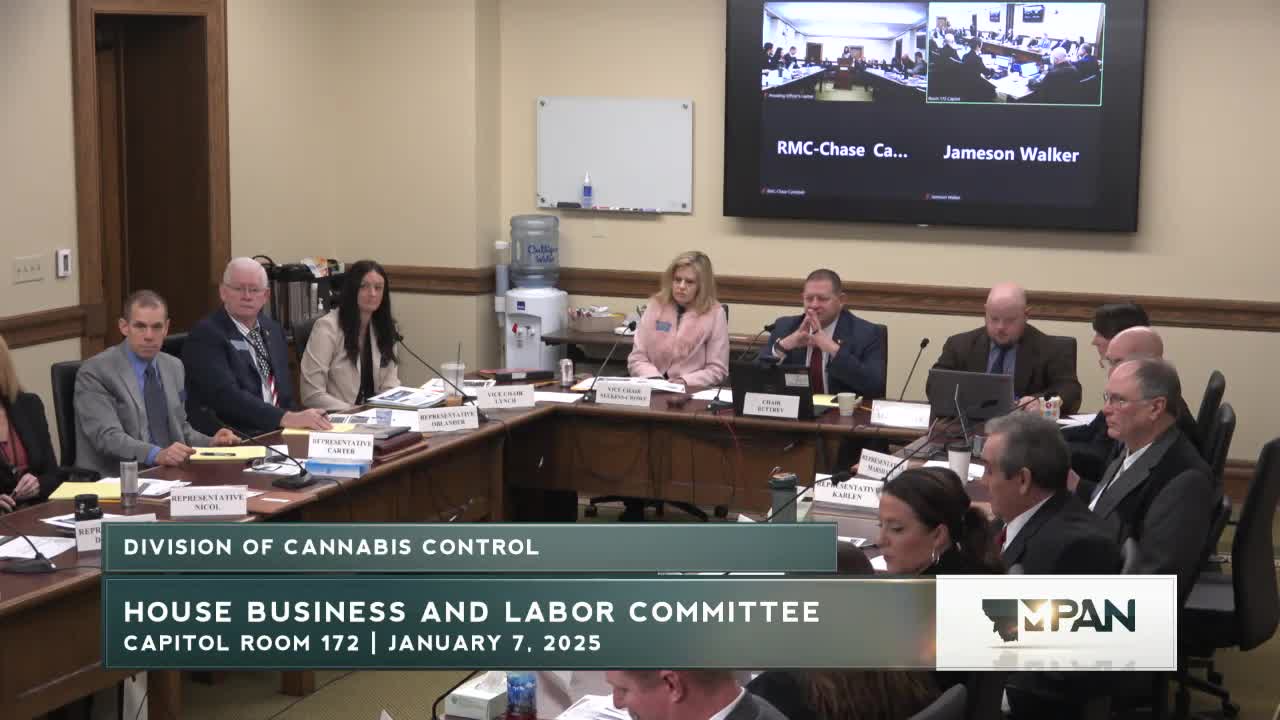
Kristen Barber, administrator of the Montana Cannabis Control Division, briefed the House Business and Labor Committee on the state’s cannabis regulatory framework Wednesday and urged lawmakers to be aware of two regulatory gaps: a temporary moratorium on new adult‑use licenses and the presence of high‑THC hemp products not subject to the cannabis rules.
Barber described how the state implemented adult‑use regulation following Initiative I‑190 and the Legislature’s House Bill 701 (the Montana Marijuana Regulation and Taxation Act). “The act set the adult use tax rate at 20%, medical at 4%, and allowed for a local option tax up to 3%,” Barber said. She highlighted that an existing moratorium prevents new cannabis licenses from being issued until July 1, 2025.
On the market size and licensing, Barber said the division oversees roughly 465 dispensary sites, issues more than 5,000 worker permits and maintains a medical‑card registry that has dropped from about 40,000 at program peak to “more than 14,000” registered medical card holders. The division’s program budget for the last biennium was “a little over $10,000,000,” and Barber told members the agency employs 35 full‑time equivalent staff.
Barber reviewed compliance and enforcement: the CCD conducts inspections (about 1,200 inspections in 2023) and uses a tiered enforcement process that includes informal civil‑violation letters and formal proposed department actions that may lead to hearings and appeals. She said HB 948 (passed in the prior session) banned synthetic cannabinoid products; CCD staff have used cease‑and‑desist authority to close unlicensed retail locations selling synthetic products and reported shutting down three locations in the previous year.
The division also moved a cannabis testing program that had been housed at the Department of Public Health and Human Services into CCD and said laboratory audit and testing work is now consolidated under one department.
Barber flagged “naturally derived hemp” products as an emerging challenge: some hemp‑derived consumables available through interstate commerce can contain concentrated delta‑9 THC at levels that make them intoxicating yet are not currently regulated under Montana’s cannabis rules. “They are available on interstate commerce. They’re available online. There’s no age gating. Kids can get a hold of them. They’re tax free,” she said. Barber said CCD had not yet proposed an agency bill to regulate hemp and that the division was coordinating with the Department of Agriculture on where regulatory lines should fall.
During Q&A, CCD legal counsel Courtney Cosgrove told members the legislature had passed a graduated dispensary fee schedule in a recent session but that a licensee challenged the law and the matter was resolved by a consent decree in litigation. Barber asked legislators to consider hemp regulation as they craft policy for marijuana and synthetic products.