Get Full Government Meeting Transcripts, Videos, & Alerts Forever!
Get email alerts on the School Meals topic
No spam. Unsubscribe anytime.
Board hears food-service review after social-media concerns; district to rebid contract
Summary
Food service staff told the New Britain Board of Education that site visits, USDA and state reviews found no expired or moldy food; the district will put its food-service contract to competitive bid and work to shift breakfast service out of classrooms.
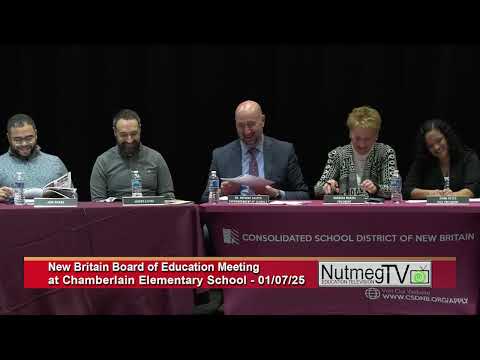
Kate Murphy, a food-service staff member, told the New Britain Board of Education on Jan. 7 that district food-service monitors visited kitchens and classrooms and did not observe spoiled or expired food.
Nut graf: The presentation laid out the results of site monitoring, corrective actions required by the Connecticut Child Nutrition Administrative Review, and a planned request-for-proposals (RFP) this year to replace the current food-service vendor. Board members and students raised questions about long lunch lines, food variety, allergens and how the district will reduce waste.
Murphy said the district served "close to 900,000 meals since the first day of school" and averages "about 11,700 meals every day." She said she conducted 18 official lunch-site monitoring visits and 12 breakfast-site visits and that the health department inspected three schools with "no findings of moldy or expired food." Murphy said she also reviewed invoices and found that the district had transitioned away from black foam trays last summer and had not ordered peaches or nectarines since the fall.
The state review produced corrective actions, Murphy said, mainly related to meal counting and claiming in classrooms and to recipes that did not clearly credit toward USDA protein or grain requirements. For example, state reviewers asked the district to revise a peanut-butter-and-jelly meal that included graham crackers; USDA classifies graham crackers as a dessert grain and limits how often they may be served. The state also asked the district to change a chicken recipe to make protein crediting clear.
Murphy outlined steps the nutrition office is taking: weekly meetings with on-site management (Winston's), student taste tests, a planned parent advisory committee with representatives from each school, additional staff training on food safety and USDA guidance, and updated recipe documentation with food-safety steps printed on each recipe.
She told the board the district is required by Connecticut to put the food-service contract out to bid every five years. "We are coming to the end of the contract with Winston's," Murphy said; the vendor has been in the district since 2003 and the last contract began July 2020. Murphy said the district will attend a mandatory state training on the RFP process on Jan. 30 and then publish an RFP for at least 45 days once the state approves the district’s draft.
Board members and students raised operational concerns. A student at New Britain High School said the lunch lines can take too long and that some stations are popular enough to create bottlenecks; the student also said some workers appeared slow to change gloves, which increased wait times. A second student recommended adding staff or reallocating staff during rush periods.
Mr. King, a board member, asked about religious accommodations and food allergies; Murphy said allergens and allergy notes appear on the register screen at point of sale and cashiers will substitute items when necessary. She said the district recently began offering a "rainbow tray" of fruits and vegetables so students have more options and are not forced to take a specific item they dislike.
On the grant question, Murphy said the district did not receive the Fresh Fruit and Vegetable grant this year and will reapply next year. She estimated there were 15 sites in prior years but said she could not name each site from memory.
On food waste, Murphy said USDA "offer versus serve" rules require students to take a fruit or vegetable component to count a reimbursable meal; the district is encouraging choice through the rainbow trays and will continue education about the program to reduce waste. She also said once food leaves the serving line for safety reasons it cannot be returned to the kitchen.
The presentation prompted the board to ask for ongoing student and parent input; Murphy said she plans monthly or bimonthly parent advisory meetings and will expand student surveys. She also said the district has opened two kiosks in the high-school cafeteria to move high-demand stations off the main serving line and speed service.
Ending: The district will proceed with state-required RFP steps and several immediate corrective actions; the board requested follow-up reporting on the RFP timeline, results of the parent advisory outreach and metrics on line times and food-waste reductions.