Public split on upzoning, neighborhood centers and HB 1110 implementation
Loading...
Summary
At the committee’s public comment and briefing, residents raised concerns about proposed upzoning, neighborhood center designations and how the city will implement House Bill 1110; affordable‑housing advocates urged bolder change.
Public commenters and planning staff clashed over the mayor’s proposed growth strategy and zoning changes to implement the 1 Seattle plan, with opponents warning of displacement and environmental harm and proponents saying more capacity is required to address the city’s housing shortage.
Opponents from several neighborhoods urged the select committee to pause or narrow the mayor’s map and to limit upzoning. Susan McCormick, a 24‑year homeowner in Madrona, said the executive’s map “goes far beyond what the state requires” and warned that five‑story buildings would “forever alter” the neighborhood and not produce affordable units. Lily Church, a 40‑year Capitol Hill and Madrona resident, told the committee “the proposed plan doesn’t actually solve affordability because density in itself doesn't translate to lower housing costs.” Denny Beckmeier of Madrona asked council to “slow down” and reassess portions of the plan that he said “exceed what is mandated by HB 1110.”
Housing advocates pressed the committee to retain the mayor’s growth strategy and expand incentives for subsidized housing. Jesse Simpson, director of government relations and policy for the Housing Development Consortium, asked council to adopt an expanded affordable‑housing density bonus and allow “stacked flats” near frequent transit to encourage middle‑housing types that can be more affordable. Josh Friedman, a land‑use lawyer with the Complete Communities Coalition, urged the committee to “be bold” and said the plan must go beyond zoning capacity and address barriers in codes that prevent housing from being built.
OPCD staff and the mayor’s office told the committee the plan would provide substantially more theoretical capacity—OPCD estimated “roughly double” the city’s current zone capacity, to about 330,000 units—but emphasized capacity is not a forecast. Michael Hebner, OPCD’s long‑range planning manager, told the committee the EIS studied alternatives and that the mayor’s option sits at the top of the draft EIS range, stressing that actual development depends on market, financing and infrastructure factors.
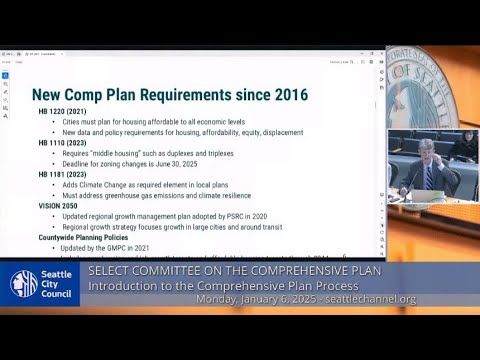
Why it matters: The discussion centers on how the city translates statutorily required changes—particularly House Bill 1110, which requires certain middle‑housing types—to local zoning maps while attempting to protect trees, limit displacement and ensure infrastructure. OPCD told the committee it will transmit neighborhood residential zoning to council in March so the city can meet HB 1110 timing but warned that appeals to the FEIS can delay council action.
Clarifying details cited at the meeting included a Maple Leaf petition opposing a neighborhood center with 743 signatures; public commenters noting the city’s tree‑canopy goals and concerns about five‑story buildings; and OPCD’s presentation that the GMPC minimum growth target equates to roughly 80,000 units over 20 years. Members of the Complete Communities Coalition urged both capacity increases and targeted incentives for subsidized housing.
Ending: Council members asked OPCD for more district‑level briefings and data on how zone capacity historically translated to actual housing built, and they requested clarifications on how the proposed map aligns with transit, infrastructure and displacement‑mitigation tools.