Get email alerts on the Comprehensive Plan Process topic
No spam. Unsubscribe anytime.
Mayor, OPCD brief council on 1 Seattle comprehensive-plan schedule and EIS
Summary
City planning staff and the mayor’s office gave the select committee an overview of the “1 Seattle” comprehensive plan update, the environmental review schedule and the sequence of legislation the council will consider over the next nine months.
City planning staff and the mayor’s office briefed the Seattle City Council Select Committee on the Comprehensive Plan on the schedule and process for the 1 Seattle comprehensive plan update and its environmental review.
The presentation on the plan led by Michael Hebner, long range planning manager in the Office of Planning and Community Development (OPCD), and Frigga Kinindongo, OPCD director, framed the update as a 10‑year statutory exercise that must plan for 20 years of growth. Chris Tobias, deputy director of policy in the mayor’s office, told the committee the mayor will transmit the plan to council and that the executive expects to send “two major pieces of legislation” for council consideration in March and May.
The briefing said the final environmental impact statement (EIS) will be released later in January and that the EIS analyzes a “preferred alternative” (the mayor’s recommended growth strategy) after a draft EIS and public comment last year. Michael Hebner said the draft EIS studied a range of housing assumptions—roughly 80,000 to 120,000 additional units over 20 years—and that the mayor’s plan occupies the top of that range. He added the plan would increase theoretical residential development capacity to roughly 330,000 units but cautioned that capacity is not a forecast.
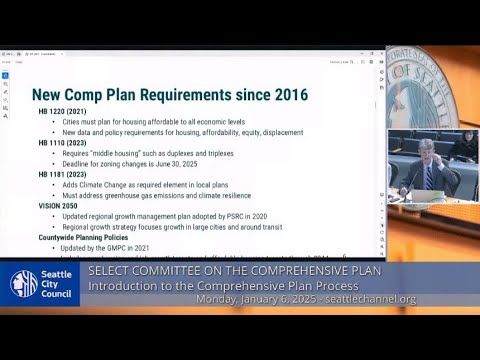
Why it matters: The committee will use the EIS and the executive’s proposals to craft ordinance language that must meet state deadlines and regional requirements. Hebner highlighted a June 30, 2025 deadline tied to implementing House Bill 1110’s zoning requirements and said council’s votes on the comprehensive plan and related zoning will be phased across spring and summer, with key council action anticipated in May and later votes on zoning refinements targeted for September.
OPCD described the council process as three linked pieces: (1) adoption of the comprehensive plan and growth strategy (transmitted early February, potential vote May), (2) neighborhood residential zoning to comply with HB 1110 (transmitted in March, vote in May), and (3) additional zoning changes for centers and corridors (transmitted in May, action by September). Lish Whitson of Council Central staff reminded members that if an FEIS is appealed, the council cannot vote on the related legislation while that appeal is pending.
Staff said public engagement on the plan has been sustained since 2022, with multiple open houses, thousands of comments and targeted outreach to community-based organizations; OPCD reported more than 6,000 individual comments and dozens of stakeholder letters during draft releases last year. The department said it will post the final EIS and additional engagement reports online and return to the committee with deeper briefings on the growth strategy and neighborhood residential code changes.
Committee chair Joy Hollingsworth thanked staff and said council members should seek pre-briefings with OPCD to prepare for amendment drafting and the 30‑day publication requirement that applies to council amendments.
The briefing closed with committee members asking for follow-up materials on the EIS timing, growth assumptions versus actual development trends, interagency coordination (Sound Transit, King County Metro, Seattle Public Utilities, City Light) and outreach summaries OPCD used to shape proposals.
Ending: OPCD and the mayor’s office will return with a deeper dive on the growth strategy, neighborhood residential zoning and EIS findings in subsequent committee meetings; council staff flagged a mid‑January FEIS publication window and a 14‑day appeal period after FEIS publication.
AI generated
The text on this page is AI generated. Summaries, highlights, analysis, and video transcripts are all produced from the original source material.
AI can make mistakes, so if you spot one, and we will fix it for everyone.
Note: the source content is unaltered by us. Any content source we link to, be it a video, an audio recording, or a document, is presented exactly as its publisher released it. That publisher is usually a government body, sometimes an individual official or another organisation.