Get Full Government Meeting Transcripts, Videos, & Alerts Forever!
Get email alerts on the Human Services Commercial Sexual Exploitation topic
No spam. Unsubscribe anytime.
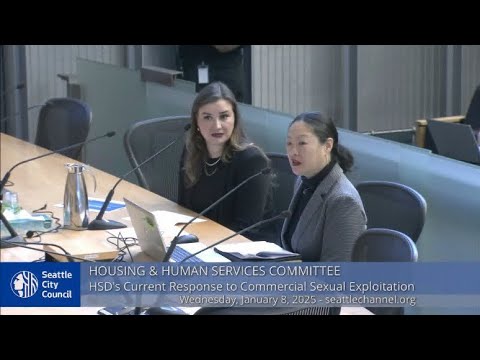
Seattle HSD outlines expanded services, coordination for commercial sexual exploitation response
Summary
Human Services Department leaders briefed the council committee on current services for commercial sexual exploitation (CSC), outlined a $2 million budget increase to expand work, described existing contracts and service models, and said a regional coordination group (CEASE) has resumed after a pandemic hiatus.
The Seattle Human Services Department on Jan. 8 told the City Council Housing and Human Services Committee it will use a newly added $2 million in base funding to expand services aimed at commercial sexual exploitation (CSC) and the commercial sexual exploitation of children (CSEC).
The presentation, led by Human Services Department Director Tanya Kim and Lisonbee Forsyth of the Mayor’s Office on Domestic Violence and Sexual Assault (MODVSA), summarized the city’s existing investments, the evidence-based service models HSD funds and the need for coordinated citywide responses that pair enforcement with survivor-centered services.
HSD said MODVSA contracts with community-based organizations to provide mobile flexible advocacy, crisis and longer-term housing, outreach and education, 24-hour hotlines, and therapeutic and medical advocacy. Kim told the committee she is “grateful to the mayor for adding $2,000,000 into our base budget” to expand that work; the department also reported it currently funds roughly $3.3 million in existing CSC-related contracts (the 2 million is new and not included in that figure).
Why it matters: HSD staff said CSC requires a multifaceted response because survivors face immediate safety needs and longer-term barriers such as housing instability, trauma and stigma. The department argued coordination across city and regional partners is necessary to reach both visible, street-based exploitation and less visible forms that occur online or in commercial businesses.
What HSD funds and why: HSD described a set of funded strategies MODVSA uses for CSC and CSEC services: mobile flexible advocacy (meeting survivors where they are to help navigate legal, medical and housing systems), shelter and housing options (crisis, transitional and long-term), outreach and education including hotlines, and therapeutic and medical advocacy such as drop-in health care programs. Forsyth emphasized survivor-centered practices—autonomy, confidentiality, trauma-informed care and culturally appropriate services—when describing service design priorities.
Coordination and planning: HSD said the city’s Coordinated Effort Against Sexual Exploitation (CEASE) work group, which was established in 2012 to identify system gaps and develop strategic recommendations, resumed in 2024 after a pandemic pause of broader convenings. HSD staff said direct service continued during the pandemic but broader coordination meetings paused while providers focused on emergency operations; the CEASE convening now serves as a forum to identify trends, gaps and strategies.
Data, demand and next steps: Committee members pressed HSD on measures of need, service capacity and how the new funds will be allocated. Staff said providers frequently report full advocate caseloads and wait lists; they described forthcoming expedited planning and a planned RFP to move the $2 million into contracts quickly. HSD said it will prioritize community engagement, coordination with regional partners (including King County), and publicity and demand-reduction efforts that recognize both visible street-based exploitation and less visible online or business-based activity.
Limitations and dependencies: HSD repeatedly cautioned that housing—particularly confidential, secure housing appropriate for survivors and families—is expensive and must account for security and privacy needs. Staff also noted that effective expansion depends on coordination with public safety partners, the city attorney, King County agencies and community providers.
Committee reaction and timeline: Committee members welcomed the briefing ahead of a planned proclamation recognizing January as Human Trafficking Prevention Month. HSD said the department will return with more detailed planning, RFP timelines and coordination materials as expedited planning and community engagement proceed.
Ending: HSD framed the Jan. 8 briefing as a primer and a start to a multi-year body of work rather than a final plan. Staff said they will follow up with lists of existing collaboratives and membership, RFP timing for the new funding and further data to help the council track capacity and outcomes.