Get Full Government Meeting Transcripts, Videos, & Alerts Forever!
Get email alerts on the Land Use Housing topic
No spam. Unsubscribe anytime.
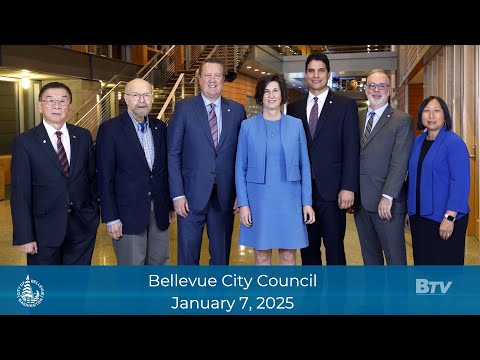
Bellevue council directs staff to finalize code changes to allow commercial-to-residential conversions under state law
Summary
At a Jan. 7 study session, Bellevue City Council directed staff to prepare a land use code amendment and Bellevue City Code changes to comply with House Bill 1042, enabling conversions of existing commercial or mixed-use buildings to residential uses with specified exemptions and incentives.
The Bellevue City Council on Jan. 7 directed staff to finalize a Land Use Code Amendment (LUCA) and a Bellevue City Code Amendment (BCCA) to implement House Bill 1042, the 2023 state law that requires cities to allow conversions of commercial or mixed-use buildings to residential use and to increase residential density in eligible zones.
The motion, moved and seconded during the council’s study session, directs staff to prepare ordinance language for final action on a future consent agenda; the motion passed by voice vote with all council members present voting aye.
What the code changes do: City staff and Planning Commission members described amendments that go beyond the state minimum in several ways while remaining consistent with HB 1042. The key provisions presented by Nick Whipple, Code and Policy Director, and Matthew Menard, Senior Planner, include:
- Applicability: Applies in districts that already allow both commercial and residential uses (mixed-use districts). An "existing building" is defined per state code as one with a certificate of occupancy issued more than three years ago. - Density and dimensional flexibility: The recommended LUCA removes an internal cap and allows the full interior area of an existing building to be used for residential units; staff said the commission recommended eliminating the 50% cap in favor of no density cap within the existing shell. - Vertical/horizontal changes: No general horizontal expansion; limited allowance of up to 5% floor-area increase to meet accessibility or fire-code retrofits; vertical additions are limited to a single-story residential penthouse or amenity where the structure can support it. - Parking and design: Projects must maintain existing parking but cannot be required to add parking to convert to residential; conversions are exempted from exterior-design and most dimensional standards, and from multifamily play-area requirements. - Ground-floor commercial: The city will limit ground-floor commercial requirements to major pedestrian corridors defined in code (downtown locations such as portions of Bellevue Way and Main Street); conversions outside those corridors may replace ground-floor retail with residential uses. - Permitting exemptions: The LUCA/BCCA would exempt eligible conversions from multimodal concurrency and SEPA review, consistent with the state law; staff will also align SEPA thresholds for mixed-use buildings.
Planning commission and outreach: Planning Commission Chair Goepel summarized a study session and a public hearing; the commission voted 4–3 to recommend the LUCA with no modifications after public comment urged removing the density cap. Staff reported outreach to developers with conversion experience, neighborhood leaders and the Bellevue development committee; staff said they had not seen broad general-public interest but received input from stakeholders and developers.
Council discussion: Members repeatedly noted that conversions are technically and financially difficult. Matthew Menard and Nick Whipple told council that market and code constraints create a funding gap for conversions — staff estimated a funding shortfall of roughly $50 to $125 per square foot in many buildings — and that the most likely candidates for conversion are certain hotels, older mid-rise office buildings with smaller floor plates, and underutilized properties near transit.
Several council members said the LUCA is one tool among many to increase housing supply and urged staff to pair the LUCA with other incentives (for example, potential MFTE expansions or other programs) to improve feasibility for developers. Councilmembers also asked staff to conduct targeted outreach to owners and developers after the ordinance is adopted so stakeholders are aware of the new option.
The council motion directing staff to finalize ordinances for the LUCA and BCCA passed and staff will return the ordinance for final action on a future consent agenda.