Get Full Government Meeting Transcripts, Videos, & Alerts Forever!
Get email alerts on the Facility Infrastructure topic
No spam. Unsubscribe anytime.
Budget request backs modular housing, lock replacements and major repairs to harden aging Georgia prisons
Summary
The governor’s proposals include modular high‑security housing units, lock and control system replacements, emergency maintenance contractors and use of private prison beds to allow renovation work, officials said at a joint appropriations hearing.
Commissioner Tyrone Oliver told the subcommittee the department needs investments in physical infrastructure to respond to a more violent offender population and to keep beds online while major projects are completed.
"Offenders are able to compromise existing security systems and controls creating dangerous conditions for personnel and other offenders," the commissioner said, summarizing consultant recommendations and the governor’s budget requests.
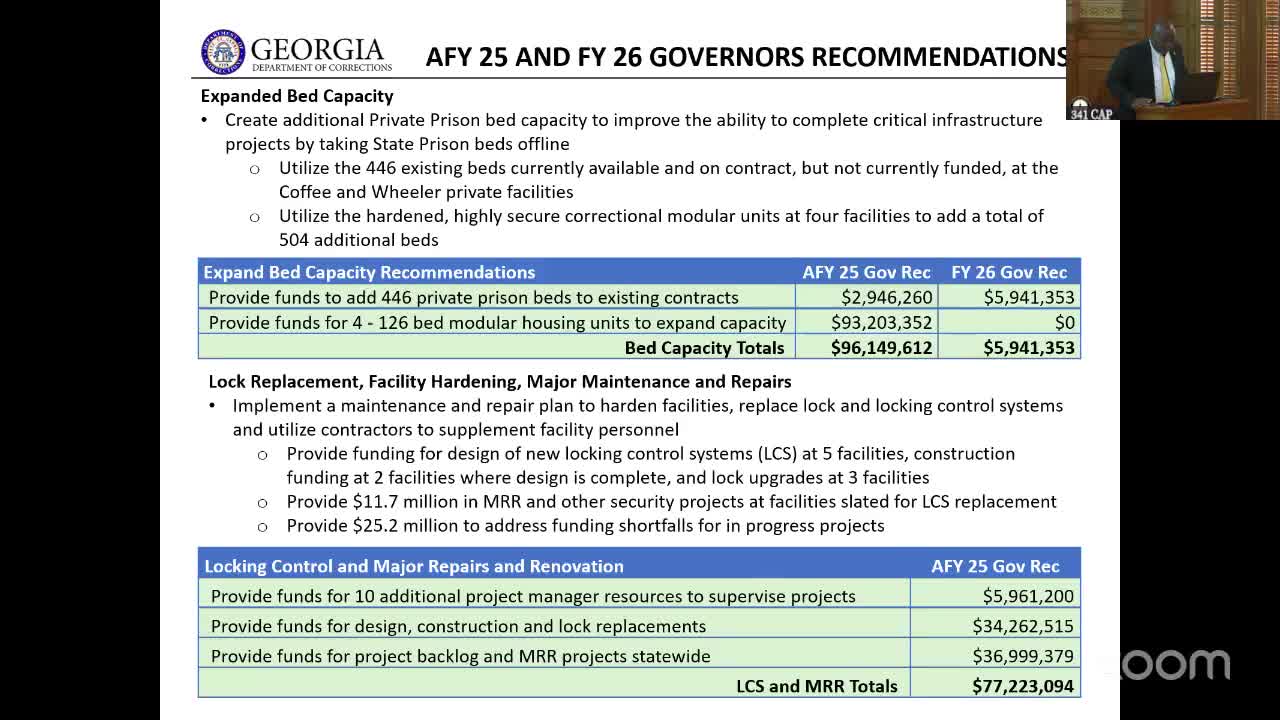
Key infrastructure components presented: - Modular high‑security housing: The request includes funding to procure four modular correctional modules (504 beds total), listed in the amended FY25 budget at about $93.2 million. The commissioner said the modules are double‑bunked units with poured concrete walls between modules and can remain on site for decades; they are intended as temporary surge capacity while lock and control system upgrades occur. - Use of contracted/private beds: The department plans to utilize 446 contract beds at private facilities to free state beds for renovation; the slide cited amended FY25 funding at about $2.9 million and FY26 at $5.9 million to lease those beds. - Lock and control modernization: The presentation proposed a multi‑year program to replace lock and control systems, including design funds at five facilities, construction at two facilities where design is complete, and staged replacements at three facilities. Slide figures included design/construction and backlog lines (examples: $34.2 million for design/construction items and $36.9 million to address backlog projects called out on slides; the commissioner also requested additional project managers and specialized contractor teams). - Emergency repairs and maintenance workforce: The request includes funds for emergency repairs ($35 million cited on a slide), 10 additional project managers and a “tiger team” of skilled craftsmen to accelerate work.
Lawmakers’ questions and context: Committee members pressed the department on per‑bed costs for modular units (one member calculated roughly $185,000 per bed on the slide figures and noted single‑occupancy would raise that figure further). Department staff said modular units are built to a higher security standard than common modular homes, include poured concrete and can be moved if necessary; they also said modular units could be on site within about 12 months.
Process and timing: The department estimated lock and control replacements would take roughly five to six years to complete under the proposed funding and that modular units plus private beds would provide interim capacity to take buildings offline for repairs. Members asked for a consolidated plan and timeline showing project start and end dates and additional cost breakdowns; the department agreed to provide that information for follow-up review.
Ending: Members expressed support for expedited repairs and urged the department to provide a single consolidated project plan to help lawmakers weigh modular procurement versus additional private‑bed leases.