Get Full Government Meeting Transcripts, Videos, & Alerts Forever!
Get email alerts on the Contraband Interdiction topic
No spam. Unsubscribe anytime.
Budget includes expanded cell‑phone interdiction, drone detection and digital forensics to stem contraband in Georgia prisons
Summary
The governor’s proposals would expand managed-access cell-phone interdiction, add drone detection systems, and fund a digital forensic unit and mail-scanning to reduce contraband and illicit communications, the corrections commissioner told lawmakers.
Commissioner Tyrone Oliver told the joint appropriations subcommittee that the governor’s budget includes technology and operational funding intended to reduce contraband — particularly cell phones and drones — which the department says enable in‑facility criminal activity.
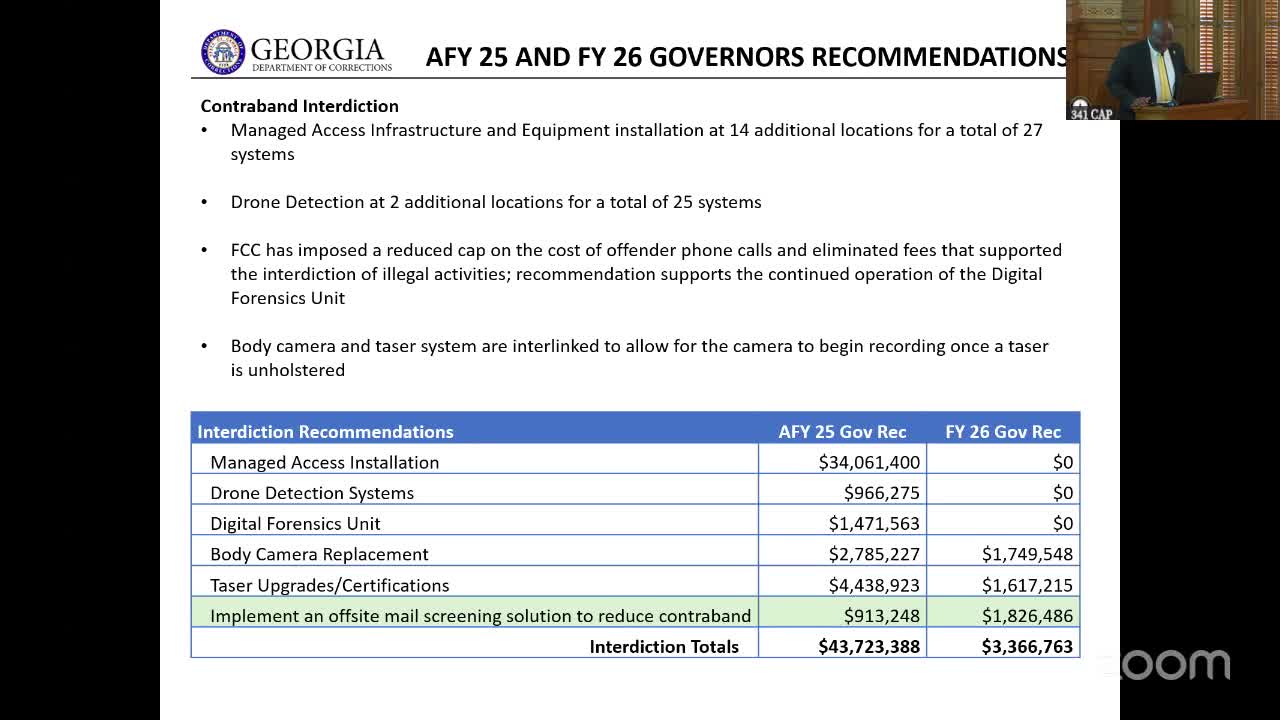
"The managed access system is all cell phone interdiction technology that we're utilizing," Commissioner Oliver said, describing the department’s plan to expand managed access coverage. He told members the request would fund managed access infrastructure and installation at 14 additional locations for a total of 27 facilities.
What the proposal covers: The department’s presentation listed multiple interdiction and investigative items: - Managed access/cell‑phone interdiction: expand to a total of 27 sites (presentation cited a combined cost line item at about $34 million for managed access installations). The commissioner said current deployment is limited to a subset of sites (two facilities with the new vendor) and that the newer managed access systems are more effective than older systems. - Drone detection: expand drone detection to two additional sites for a total of 25 systems (presentation figure cited about $966,000). - Digital Forensic Unit: continued funding to process contraband phones and devices (the presentation cited $1.4 million to continue this unit and its investigations). - Mail scanning (off‑site mail processing): implement an off‑site vendor to scan inmate mail before it enters facilities; the FY25 amended request included $900,000 with an annualized FY26 figure of $1.8 million listed in the slide deck.
Why it matters: Lawmakers pressed the department about effectiveness, deployment and interactions with other security upgrades. Representatives said small counties sometimes respond to drone incidents that target state prisons; several members urged an aggressive approach. Commissioner Oliver described managed access and newer vendor systems as “very sophisticated” and said testing showed improved interdiction compared with older systems.
Operational questions and clarifications: Committee members asked how the tablet program interfaces with interdiction goals (tablets run on a separate Wi‑Fi network, the commissioner said), and whether additional managed‑access coverage could be scaled fast enough. The department said it can provide more detailed operational outcomes and noted some technical details were withheld from public testimony for security reasons.
Remaining work: Members requested additional detail about current coverage, vendor capabilities, deployment timeframes and the precise breakdown of interdiction costs. The department agreed to supply additional information to the subcommittee for follow-up review.