Get Full Government Meeting Transcripts, Videos, & Alerts Forever!
Get email alerts on the Wetlands Conservation topic
No spam. Unsubscribe anytime.
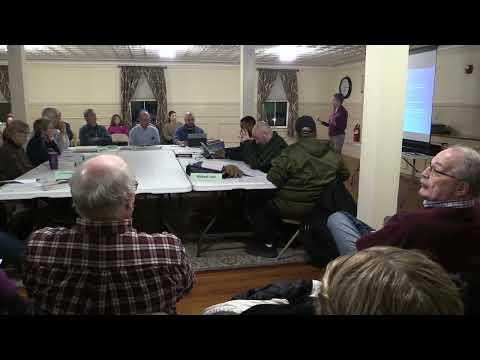
Swansea Planning Board hears hours of public comment on wetlands amendments; splits on recommendations to warrant
Summary
The Swansea Planning Board held a public hearing Jan. 9 on a package of zoning amendments to create a Wetlands Conservation District and a 75-foot upland buffer; conservation members and dozens of residents debated environmental protection, property rights and the economic impacts of the draft language.
The Swansea Planning Board held a public hearing Jan. 9 on a package of zoning amendments the Conservation Commission proposes to create a Wetlands Conservation District (WCD) and add a 75-foot naturally vegetated upland buffer around wetlands. The board and members of the public debated habitat protection, septic setbacks, development limits and how property owners would seek relief through variances or a conditional-use process.
The Conservation Commission presenter, Sherry, summarized the town’s ecological review and why the commission proposed changes. “We have 374 wetlands in Swansea,” Sherry said, and “wetlands number about 2,824 acres in Swansea.” She said the commission hired an ecological consultant in 2023 to evaluate town wetlands and found many sites lack naturally vegetated buffers that protect flood storage, groundwater recharge and wildlife habitat.
Why this matters: supporters said the changes are intended to preserve flood control and water quality, and to bring local rules into alignment with a recent wetlands evaluation and the town’s open-space plan. Opponents — including engineers, local business owners and several residents — warned the proposed text as written would impose steep limits on property use, create practical takings for some lots and block reasonable access or development in areas that the town previously invested to develop.
Engineer John Newman of Gilstone Consultants showed multiple commercial parcels in the Safford Drive industrial area and said the proposed buffer would remove large swaths of previously developable land. “This project would almost be…nonbuildable at this point,” Newman said, describing sites where the buffer would eliminate driveways, parking or buildable footprints. Former town planner Sarah Carboneau said she supported wetland protection but told the board that as written “it is basically a taking or could be considered a taking of one’s private property” because the draft lacks a conditional-use or other relief mechanism.
Public comment and written input were extensive. The board read letters supporting stronger protections (from Kimberly Miller and Connor Maroney) and a formal letter from the Swansea Board of Selectmen urging more time and collaboration before placing the articles on the warrant. The selectmen said the packet contained “complex changes” with “unanticipated consequences,” flagged potential impacts on the TIF-funded Safford Drive industrial area and recommended additional review with engineers, the planning department and economic-development advisers.
The Planning Board spent the hearing moving through discrete amendments (Amendment 1 and Amendments 8–12). The board’s recommendations to the warrant, as recorded at the meeting, were mixed: the board voted to move Amendment 1 to the warrant; it supported Amendment 9 and Amendment 12; it voted not to recommend Amendment 10 and Amendment 11; for Amendment 8 the board recorded a motion to not support the amendment that the transcript shows did not pass. Regardless of the board’s recommendation in many cases, petition items and warrant-eligible zoning amendments proceed to the town warrant for voter consideration.
Votes at a glance
- Amendment 1 (definitions: business offices, service establishment, retail establishment; remove “professional”): Motion to move to the warrant (mover: Michael York; second: Mark Scalera). Board action: forwarded to the warrant.
- Amendment 8 (create WCD defined to include wetlands plus uplands within 75 feet; incorporate RSA reference; definitions/structure): A motion to not support Amendment 8 was made; the transcript records the motion and multiple speakers but shows the motion “did not pass” as recorded by the chair. The board’s recorded disposition at the meeting did not result in a final affirmative recommendation in favor of the proposed text.
- Amendment 9 (delineation / definition of wetlands, cites US Army Corps of Engineers manual as methodology): Motion to support (mover: Mark Scalera; second: Richard Lane). Board action: supported/recommended to warrant.
- Amendment 10 (permitted uses and clarifications; changes to allowed activities within the proposed WCD): Motion to not recommend (mover and second recorded in meeting record). Board action: not recommended.
- Amendment 11 (setbacks, septic tank/advanced treatment setbacks reduced from 125 ft to 75 ft, new prohibitions on structures and parking within buffer): Motion to not recommend (mover: Brandon Selle; second: Richard Lane). Board action: not recommended.
- Amendment 12 (exemptions for certain man-made features such as existing stormwater basins, agricultural ponds, fire ponds): Motion to place on warrant (mover/second recorded). Board action: recommended to warrant.
Discussion vs. direction vs. decision: Most of the hearing was discussion and public comment; where the board took formal action it was limited to whether the planning board would recommend the amendment to be placed on the town warrant. Multiple speakers urged the board to add a conditional-use permit or special-exception process to give landowners a path for relief; several engineers and business owners requested additional study of impacts on TIF infrastructure (Safford Drive) and on current commercial lots.
Clarifying technical details offered during the hearing: the draft would reduce the town’s existing 125-foot septic setback to a 75-foot septic setback in line with state minimums for septic setbacks; the proposed buffer language would require a naturally vegetated buffer and prohibit routine mowing and pesticide/herbicide spraying in the buffer area; certain man-made features (man-made ditches, stormwater swales, farm ponds, fire ponds) were proposed to be exempted.
What’s next: Several board members and the selectmen urged continued work between the Conservation Commission, Planning Department, engineering consultants and economic advisers before finalizing a suite of ordinances. Multiple petition items will appear on the 2025 warrant regardless of the board’s recommendation because of the petition process; where the board recommended changes, that recommendation will be recorded in the planning board’s report to voters.
Ending: The hearing drew numerous detailed technical presentations, extensive public comment and a split planning-board response. The Conservation Commission and planning staff said they will continue work on buffer language and relief mechanisms; the articles will appear on the 2025 warrant as required by the petition process and council motion timelines.