Get Full Government Meeting Transcripts, Videos, & Alerts Forever!
Get email alerts on the Parking Reform topic
No spam. Unsubscribe anytime.
Planning commission backs removing minimum parking rules citywide under state CFEC requirements
Summary
Commissioners reviewed Climate‑Friendly and Equitable Communities (CFEC) parking compliance options and development‑code amendments and agreed to recommend the option that removes minimum parking requirements citywide, citing that most of Wilsonville already falls under transit‑proximity exemptions and to avoid administrative complexity.
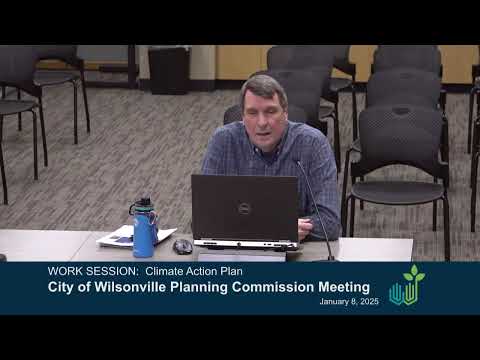
The Planning Commission reviewed options to comply with the state’s Climate‑Friendly and Equitable Communities (CFEC) parking rules at a Jan. 18, 2025 work session and agreed to advance a recommendation to city council to remove minimum parking requirements citywide (the staff‑recommended Option 1).
Daniel Polley, Wilsonville’s planning manager, introduced the item and said it focuses on the state parking B compliance options and several development code amendments that the city must adopt or clarify to meet CFEC rules. He said staff’s recommendation reflected an analysis showing that a large share of Wilsonville is already exempt from parking minimums under the state’s transit‑proximity rule.
Brian Davis of Studio Davis — serving as the city’s consultant on parking reforms — summarized the three compliance approaches available under the state rules: (1) eliminate parking minimums citywide; (2) retain minimums outside transit‑proximate or climate‑friendly areas and adopt an array of reforms for the nonexempt areas; or (3) retain minimums outside the exempt areas but implement a different package of mandatory requirements. Davis told commissioners the majority of other Oregon cities that have completed compliance work have chosen Option 1 for administrative simplicity and because the transit‑proximity buffers already cover most buildable land.
Polley and Davis outlined development‑code amendments the city must adopt regardless of which compliance option is chosen. These include requirements or options to:
- Allow and facilitate redevelopment of underused parking and shared‑parking arrangements (the code must not prohibit sharing and should make shared agreements administratively feasible). - Require new surface parking to meet either tree‑canopy thresholds or include solar generation, or in some cases allow a fee‑in‑lieu instead (the state expects cities to provide incentives or alternatives that reduce surface‑parking impacts). - Require EV readiness infrastructure (conduit and related infrastructure) for a portion of newly constructed parking so that up to 40 percent of spaces can be electrified in the future; the city may phase or adjust thresholds in code. - Update bike‑parking provisions and ensure parking maximums in transit buffers align with state limits; the 3‑quarter‑mile rail station buffer and half‑mile frequent‑transit buffer result in most of the city already being subject to the state exemption that removes parking minimums.
Commission discussion focused on the tradeoffs among the options and administrative burden. Commissioners asked for data on what percentage of the city’s land would be affected by each option and emphasized a preference for a single, consistent rule set. Multiple commissioners argued that option 1 reduces future complexity because transit service frequency and route changes would otherwise require repeated map updates. Several commissioners supported citywide parking maximums and encouraged code language that favors facilitation and incentives rather than prescriptive mandates where the state allows discretion.
Polley told the commission staff will calculate precise percentages of city land already covered by transit‑proximity exemptions and return code language for additional review. At the meeting’s close, commissioners directed staff to take Option 1 forward as the recommendation to city council.
Ending: Staff said it will draft code amendments and return to the commission for further review, host public outreach, and then bring an ordinance to city council as part of the CFEC compliance schedule.