Get Full Government Meeting Transcripts, Videos, & Alerts Forever!
Get email alerts on the Climate Action Plan topic
No spam. Unsubscribe anytime.
Wilsonville planners review greenhouse‑gas inventory, scenarios and draft low‑carbon actions
Summary
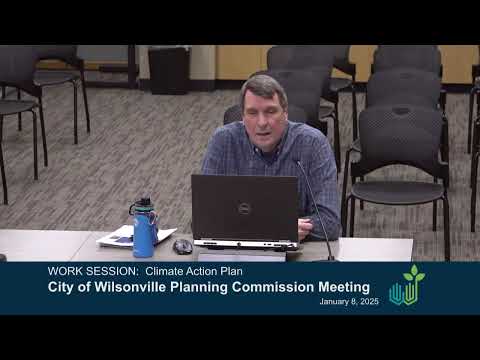
Wilsonville city staff and consultants presented a greenhouse‑gas inventory and two modeled futures on Jan. 18, 2025, showing transportation is the largest local source of energy use and emissions and asking the Planning Commission to weigh draft low‑carbon actions and implementation measures before further modeling.
Wilsonville city staff and consultants presented a greenhouse‑gas inventory and scenario modeling during a Planning Commission work session on Jan. 18, 2025, outlining options the city will model as it develops a climate action plan.
Kerry Rappel, the city’s natural resources manager, introduced the project and said the consultant team from SSG has completed a community and municipal inventory and two modeled futures — a business‑as‑usual (BAU) and a business‑as‑planned (BAP) scenario — and will later model a low‑carbon scenario if the commission identifies which actions to include.
The inventory and modeling team said transportation is the largest sector of energy use and emissions. Hilary Beatty, an SSG consultant, summarized the inventory: “Transportation accounts for nearly half, or 48 percent, of the city's energy consumption,” and she reported transportation produced about 46 percent of Wilsonville’s greenhouse‑gas emissions in 2021. Commercial buildings accounted for roughly 22 percent of energy use (24 percent of emissions), residential buildings 18 percent of energy use (15 percent of emissions), industry 12 percent of energy use (14 percent of emissions), and solid waste about 1 percent of emissions, mostly from landfill decomposition.
SSG projected two futures. Under the BAU scenario — where change is limited to population and economic growth, fuel‑efficiency standards and climate warming — community emissions rise about 19 percent, from roughly 292,000 metric tons of CO2e in 2021 to about 347,000 tons in 2050. Under the BAP scenario, which adds the assumed effect of approved and funded statewide policies, community emissions increase about 1 percent between 2021 and 2050.
The consultants said the BAP assumptions include Oregon’s statewide car and truck standards (Clean Cars 2 and the clean truck rules), periodic improvements to building codes, and Wilsonville’s tree‑canopy goal. The inventory used a population growth assumption of about 14 percent between 2019 and 2039 and assumed employment grows with population. The planners noted sequestration from existing tree canopy is included in the inventory and that the city’s Urban Forest Management Plan sets a canopy goal that the consultants modeled as increasing from about 30 percent to 36 percent by 2046.
Maria Braun, an SSG consultant, described how a later low‑carbon scenario will be modeled as a set of “wedges,” each representing quantified actions that reduce emissions. She drew the commission’s attention to the difference between an "action" — a quantified change that can be modeled, such as shifting mode share — and an "implementation measure" — policies or incentives to cause that change, such as fare reductions or infrastructure investment.
Draft low‑carbon actions presented for discussion included: planning and building measures to increase density and building efficiency; transportation strategies to encourage mode shift to transit, carpooling and active transportation plus electrification of remaining vehicle trips; industrial energy reductions tailored to industry type; increased rooftop and community solar and options for procuring carbon‑free electricity; and waste measures including organic‑waste diversion and consideration of renewable natural gas from anaerobic digestion at wastewater facilities.
Commissioners requested more detail and additional modeling in several areas. Multiple commissioners urged stronger transportation measures and more transportation‑sector actions in the low‑carbon list, citing the sector’s dominant emissions share and local congestion patterns. Commissioners asked for:
- A clearer accounting of how transit and infrastructure investments would affect mode shift targets and model outcomes, including the potential effect of future highway or bridge projects on local traffic and emissions; - More analysis of incentives and financing to support retrofits of existing buildings and solar installations for existing commercial and residential structures; - Feasibility and logistics studies for renewable natural gas (RNG) at wastewater facilities and an assessment of the wastewater master plan’s recent capital investment; and - High‑level cost or “pain” estimates to help prioritize actions by cost‑effectiveness and near‑term affordability impacts.
Staff and consultants said they can provide additional cost magnitude estimates during the implementation and financial analysis phases of modeling and that federal funding streams, including programs tied to the Inflation Reduction Act and EPA allocations, are being monitored as potential sources to support implementation.
Rappel and the consultants described planned engagement steps: a public open house and an industry forum, a business‑targeted survey on the city’s "Let’s Talk" site, outreach to about 50 businesses and direct outreach to school students at primary, middle and high school levels. The presentation packet also referenced a public survey that had closed in late November. Staff announced a public open house scheduled at City Hall in the Willamette River rooms from 6 to 8 p.m. on January 16; staff said the industry forum is scheduled for noon the same day.
Next steps described to the commission were additional stakeholder outreach, refinement of the low‑carbon action list based on feedback, completion of the low‑carbon scenario modeling, drafting of the plan, and subsequent review for adoption in late spring to early summer 2025.
No formal actions or votes were taken during the work session; the item was a staff presentation and commission discussion.
Ending: The commission provided detailed input, requested additional modeling around transportation measures, costs and incentive design, and directed staff and consultants to incorporate feedback into the next draft and modeling cycle before the plan is returned for formal review later in spring 2025.