Get Full Government Meeting Transcripts, Videos, & Alerts Forever!
Get email alerts on the Municipal Finance Bonds topic
No spam. Unsubscribe anytime.
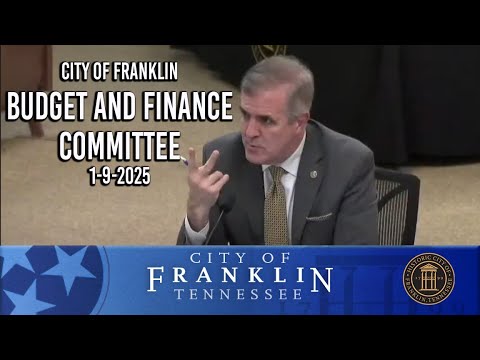
Franklin officials outline $48 million general obligation bond plan, no vote taken due to lack of quorum
Summary
City of Franklin staff and outside bond advisers on Thursday presented two companion authorizing resolutions — 2024-116 and 2024-117 — that, if approved by the Board of Mayor and Aldermen, would allow the city to issue up to $48,000,000 in general obligation bonds to finance parks, major road resurfacing and public safety equipment.
City of Franklin staff and outside bond advisers on Thursday presented two companion authorizing resolutions — 2024-116 and 2024-117 — that, if approved by the Board of Mayor and Aldermen, would allow the city to issue up to $48,000,000 in general obligation bonds to finance parks, major road resurfacing and public safety equipment.
The presentation to the Budget & Finance Committee did not include a vote because the committee lacked a quorum. Staff said the two resolutions will be discussed at a Board work session on Jan. 28 and considered at the Board of Mayor and Aldermen meeting on Feb. 11.
The bond package covers four project categories, including replacement fire apparatus, a major road-resurfacing program, Southeast Park Phase 1 and McEwen Drive Phase 4. Michael Walters Young, chief budget performance officer, said $30,000,000 of the request is intended for Southeast Park Phase 1 of an estimated $64,800,000 project cost; about $12,000,000 has already been spent on the project, primarily for a bridge. McEwen Phase 4 carries an estimated all-in cost of $55,400,000, of which staff said about $30,000,000 is expected to come from federal and state grants and roughly $14,000,000 from road impact fees; $5,000,000 was identified for early utility relocation work.
Lillian Blackshear, bond counsel with Bass, Berry & Sims, told the committee that the bonds would be secured by “a full faith and credit pledge of the city,” and that the financing is expected to be tax-exempt government debt. “Franklin has a very strong GO credit rating, AAA — can't get any better than that,” Blackshear said, noting that the rating will help in the market.
Lauren Lowe, the city's financial adviser from PFM, described the competitive public sale process required by state law: staff would publish the initial authorizing resolution, seek credit ratings from Moody’s and S&P, issue offering documents (preliminary official statement and notice of sale), receive competitive bids through an electronic platform and award the sale based on lowest true interest cost. Lowe said the timeline staff has proposed would put pricing and closing in March 2025, with flexibility to move a day or two depending on market conditions.
Counsel and advisers provided preliminary structuring assumptions prepared in mid-December: an estimated true interest cost range of about 3.75% to 4.25% and modeled debt service beginning in fiscal 2026. Counsel provided an illustrative repayment pattern showing roughly $4.4 million in annual principal and interest in FY2026–2035, declining thereafter to about $2.9 million in 2036–2040 and about $2.6 million in 2041–2045, reflecting different repayment terms tied to asset lives (fire apparatus over 15 years, major resurfacing over 10 years, parks and road improvements over 20 years).
Staff emphasized timing and tax-exempt rules: to qualify for tax-exempt treatment, proceeds must be spent within specified time windows and the city should have reasonable assurance the projects will be expended promptly. “We do need to have assurances that those funds will be spent — primarily spent within 36 months,” a staff member said when describing tax-exempt spending rules and project readiness.
Because the committee lacked a quorum, no motion or vote was taken. Staff said the resolutions will be published as required by state law and present the authorizing resolutions for public consideration at the Board work session on Jan. 28 and for potential approval at the Board meeting on Feb. 11.
If approved, the sale would be a competitive public offering under Tennessee law (Title 9, Chapter 21), with closing expected in Q1 2025 or early Q2 depending on market conditions and rating-agency timing.
Questions from members focused on how potential future state projects (for example, partnering on Mack Hatcher-type improvements) might be financed; staff said general obligation debt could be one tool if timing, scope and intergovernmental agreements were clear. Officials also noted the city has not issued G.O. debt for new projects since 2019 and that two of the projects in this package have already reached stages where reimbursements or immediate expenditures are expected.
Next steps from staff: publish the initial authorizing resolution, engage rating agencies, finalize offering documents, market the bonds, receive and evaluate competitive bids and, if favorable, award and close the sale. No final decisions were made at the committee meeting.