Get Full Government Meeting Transcripts, Videos, & Alerts Forever!
Get email alerts on the Special Education Audit topic
No spam. Unsubscribe anytime.
Rebus Associates audit finds gaps in Tewksbury special-education supports; recommends phased 2–5 year plan
Summary
A third-party audit of Tewksbury Public Schools identified 11 themes for improvement — including inconsistent Tier 1 interventions, uneven transition planning and staffing configuration — and recommended a phased implementation plan emphasizing data analysis, professional development and clearer family communications.
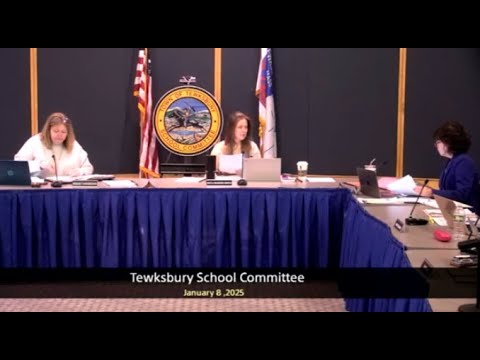
A third-party audit presented to the Tewksbury School Committee on Jan. 8, 2025 concluded the district has strengths in special-education programming but identified multiple areas needing sustained improvement, including inconsistent general-education Tier 1 interventions, uneven transition planning across buildings and questions about case-manager and paraprofessional assignments.
The audit was delivered by Cindy Tamore and William Lupini of Rebus Associates, who said the report organizes findings into 11 themes and offers a mix of “no/low cost” actions and longer-term steps that will likely take years to institutionalize. "Tier 1 support is in the classroom. It is the general-education teacher's responsibility," Tamore told the committee as she described the district’s need to make interventions both visible and reliable across schools.
Why it matters: The auditors said improving regular-education interventions and data systems can reduce referrals to special education and Section 504 plans — a financial and service-quality issue for the district. Rebus noted Tewksbury’s proportion of students with disabilities (special education plus 504 accommodations) is high — about 30% — and that the district had roughly 81 out-of-district placements at the time of the review, a figure the consultants said carries substantial cost implications.
Major findings and recommendations
- Strengthen and publicize Tier 1 interventions (MTSS): The consultants recommended making the district’s tiered-support processes explicit, visible to parents and staff, and a regular part of professional development so teachers can use interventions before families pursue special-education referrals. Tamore and Lupini urged a careful rollout: "For tier 1 to be institutionalized, we would put five years on it; two years to begin implementation," Lupini said.
- Conduct an in-depth data analysis: Rebus urged the district to analyze where and when students move onto IEPs or 504 plans (for example, at middle-school transition points) so the district can address inflection points proactively.
- Reconfigure case-manager assignments: The audit recommends assigning case managers to contiguous school groupings (so a case manager follows students across the next school) and expanding certain evaluative responsibilities to reduce bottlenecks and improve continuity.
- Clarify preschool leadership and transition planning: The consultants recommended a dedicated preschool director to supervise programs, coach staff, and smooth the shift from early intervention to public-school services. They also stressed that postsecondary transition planning must begin at age 14 and recommended greater coordination with adult services.
- Tighten paraprofessional processes: Rebus recommended a defined district process (not informal workarounds) for approving one-on-one paraprofessional supports, clearer role definitions and multi‑skill training so paras can be reassigned without undermining student independence.
- Increase targeted professional development and centralize resources: The report calls for more sustained PD (beyond the existing days), use of faculty meeting time for high-leverage strategies, classroom coaching, and a central, searchable repository of intervention materials and protocols.
- Improve educator-evaluation consistency: Auditors found variation in how the evaluation system is implemented across buildings and recommended calibration and alignment of goals and observation targets to district priorities.
Implementation and timeline
Rebus Associates emphasized a phased approach organized into low-cost, moderate-cost and higher-cost actions, and suggested a multi-year timeline. District leaders told the committee they will prioritize items that can be started quickly (policy clarification, case-manager assignments, public communication of available supports) while planning longer-term work (staffing changes, preschool leadership, bargaining-related items) over 3–5 years.
District response and next steps
Superintendent and central-office leaders said they already have documents (DCAPs, MTSS plans) in place and will focus first on professional development so existing tools are used consistently. The administration told the school committee it plans to map recommendations into actionable priorities, to report progress to the committee, and to involve parents, CPAC and staff in implementation. Committee members asked for quarterly or twice‑annual checkpoints and regular agenda items so the public can follow progress.
Ending
Rebus Associates concluded that while many of the district’s programs are well designed on paper, inconsistent implementation and uneven communication have driven referrals out of general education into formal special-education pathways. The consultants left the committee with a recommended roadmap and urged the district to set measurable indicators for success and to monitor them over time.