Get Full Government Meeting Transcripts, Videos, & Alerts Forever!
Get email alerts on the K 12 Assessment topic
No spam. Unsubscribe anytime.
State removes MCAS as sole competency measure; Beverly schools to use personalized learning plans for some seniors
Summary
Massachusetts removed MCAS as the only way to demonstrate high-school competency; Beverly Public Schools will use personalized learning plans (formerly EPPs) for impacted seniors and rely on coursework, benchmarks and other demonstrations for future cohorts.
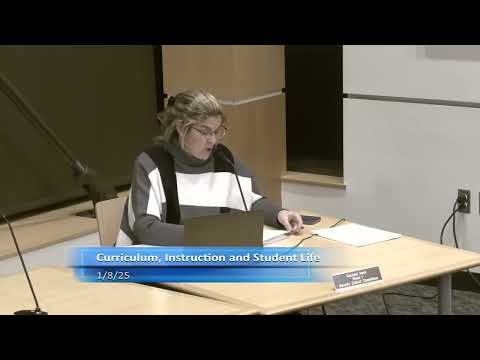
Dorothy Flaherty, Beverly Public Schools assistant superintendent, told the School Committee’s Curriculum, Instruction and Student Life meeting on Jan. 8 that a state law change removed MCAS as the sole measure for high-school competency determination.
Flaherty said the law, which took effect in December, “removed MCAS as the requirement for grade 10 to prove competency determination,” and that MCAS “is no longer a measure of competency determination or required for high school graduation.” She stressed the change does not eliminate MCAS testing itself; the state will still use MCAS participation rates for school and district accountability.
The change means students can demonstrate mastery in English language arts, math and at least one science discipline through alternatives such as course grades, benchmark assessments, projects or midterms. For students who already passed retests given before the law change, Flaherty said those results still count toward competency determination.
Flaherty and Principal Mark Thomas described short-, mid- and long-term responses. For current seniors who have not met the previous MCAS-based competency determination, the district will use personalized learning plans (PLPs), the successor to what had been called an EPP, to record and review coursework, benchmarks and teacher input to show mastery in the relevant content areas. Flaherty said the high school had about 10 students affected this year who will be worked with individually.
The district will treat competency determination as distinct from graduation-course requirements. Flaherty explained: graduation requirements are the courses students must complete; competency determination is how students show mastery of the state standards in ELA, math and a science area. She said districts should prepare separate statements on graduation requirements and competency determination, per DESE recommendation.
On participation and accountability, Flaherty said the Department of Elementary and Secondary Education (DESE) is still holding a 95% MCAS participation floor for accountability calculations and that “participation in MCAS testing at the high school remains a requirement by both federal and state law.” She added DESE will continue to decide whether to offer future statewide retests.
Flaherty said the practical consequences for students who have not demonstrated competency may include summer school or other remedial steps to show mastery before their intended graduation date. She also warned the state could still adopt further guidance in future years on how districts must document competency determination.
The district intends to present formal competency-determination language to the full School Committee in 2025 and to provide guidance to students and families about PLPs, retest options, and how course work will be used for mastery demonstrations.
Questions and clarifications in the meeting focused on timeline and whether passing later courses (for example, English 11) could substitute for showing mastery of English 10 standards; Flaherty confirmed that deeper work in higher-level courses can demonstrate mastery of earlier-grade standards if documented.