Get Full Government Meeting Transcripts, Videos, & Alerts Forever!
Get email alerts on the Fafsa Application topic
No spam. Unsubscribe anytime.
Spanish-language FAFSA walkthrough explains FSA ID, IRS consent and MAP eligibility
Summary
A presenter gave a Spanish-language, step-by-step walkthrough of the Free Application for Federal Student Aid (FAFSA), covering FSA ID login, IRS data transfer consent, parental information rules, independent-student criteria, Illinois MAP and Pell grant basics, and where students can get in-person help.
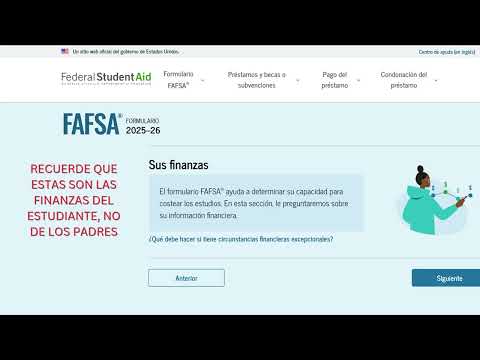
Staff member, the presenter, led a Spanish-language step-by-step demonstration of the Free Application for Federal Student Aid (FAFSA), describing how students and parents should log in with an FSA ID, consent to import tax data from the IRS and complete sections that determine state and federal aid eligibility.
The presenter said applicants must sign in with their FSA ID — “tu identificación de fafsa, o sea, el FSA ID” — and that parents or legal guardians must also have an FSA ID to be invited to complete parental sections. The presenter demonstrated selecting “student” or “parent,” starting a new FAFSA, and clicking “start FAFSA form” to view personal information tied to the FSA ID, including name, birth date, Social Security number or ITIN, address and phone number.
The session emphasized the IRS data-transfer step. The presenter explained that applicants must review and approve consent to connect the Federal Student Aid portal to the IRS so federal tax data can populate the FAFSA automatically. The presenter noted the system will match information by Social Security number or an ITIN for parents who lack Social Security numbers and said this avoids manual tax-entry errors.
The walkthrough covered how the FAFSA classifies applicants as independent or dependent and which questions affect that status: marital status, prior bachelor’s degree, homeless or at-risk housing history, and whether parents are unavailable or refuse to provide information. The presenter said students who indicate homelessness or an inability to contact parents may be treated as independent, but the form may require district verification (for example, a liaison form to verify homelessness).
On parental data, the presenter instructed applicants to provide information for both parents if they are married or living together and to indicate which parent provided more financial support if parents are separated. The presenter noted that if a parent does not have a Social Security number, the FAFSA allows entry of an ITIN and that a parent who remarries may require additional steps when entering household information.
The presenter explained the parent-invitation workflow: students can invite a parent through the FAFSA portal; the invited parent must accept the invitation and sign in with their own FSA ID to complete the parental portion. The presenter warned that once certain steps are finished, applicants cannot return to earlier parts of the form and would need to start the application again to correct major errors.
The session described how family-size and the number of family members attending college affect aid calculations and instructed applicants to report changes (for example, a new family member) so the Student Aid Index (SAI) reflects current circumstances. The presenter said applicants should enter the number of family members who will attend college in the coming school year.
State and federal aid basics were summarized: the presenter said Illinois students must attend an eligible in-state school to receive the Illinois Monetary Award Program (MAP) grant and stated that MAP can award up to $8,000 to qualifying students. The presenter contrasted MAP with the federal Pell Grant (referred to in the session as “PEL”), noting the Pell Grant is a separate federal award and may differ in amount from MAP. The presenter also explained each FAFSA can be sent to up to 20 schools and recommended listing all applied-to schools at once to avoid repeating steps.
The presenter described the final screens: green checkmarks indicate completed sections, applicants click to sign and submit, and the estimated Student Aid Index (SAI) will appear after parental information is complete. The presenter said final award amounts — including MAP or Pell eligibility — will be reflected in schools’ financial aid award letters, which are typically mailed in the spring.
For help, the presenter invited attendees to visit the presenter’s office at the College and Career Center, room A-307 (“Centro de Universidades y Carreras, salón A trescientos siete”), for in-person assistance with completing the FAFSA.
"Haz clic en continuar," the presenter repeated during several steps to instruct users to move forward in the portal.
The demonstration provided procedural guidance and did not include any formal vote or policy decision.