Get Full Government Meeting Transcripts, Videos, & Alerts Forever!
Get email alerts on the Departmental Report topic
No spam. Unsubscribe anytime.
City manager reviews 2024 accomplishments and 2025 projects, highlights water resiliency and airport expansion
Summary
City Manager Warren Wood told the Jan. 7 Hickory City Council the city will prioritize water resiliency, wastewater capacity projects and several grant-funded transportation, airport and park projects in 2025, and highlighted near-term construction and permitting steps.
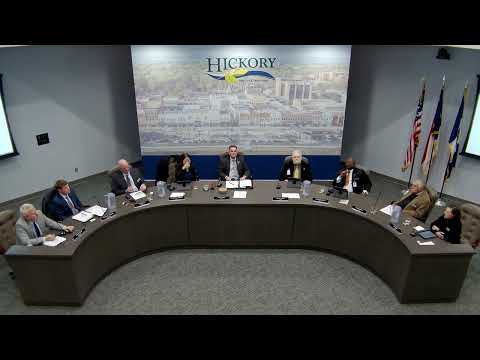
City Manager Warren Wood on Jan. 7 delivered the Hickory City Council’s year-in-review and a look ahead at 2025, emphasizing water and wastewater resiliency, transportation and airport projects, park improvements and the city’s bond-and-grant-driven capital program.
Wood said the city is selecting a design firm to renovate storage at the former Longview water plant, is conducting a feasibility study on interconnectivity with nearby water systems, and is evaluating the need for a second water treatment plant and a secondary water intake. He said the city will select a firm this year to implement an advanced metering infrastructure (AMI) program to automate meter reading over roughly a three-year rollout and to improve leak detection and data-driven capital planning.
Wood described two FEMA-funded pump station projects (Falling Creek and Snow Creek) scheduled to begin construction this year to protect pump stations from flooding, and he described work to divert some flow from the Moose Club pump station toward the Henry Fork wastewater plant to relieve capacity constraints and enable additional west-side growth. He said the recent Murray Basin sewer-line project redirected flows away from Conover to the city’s Henry Fork plant and will pay for itself over time.
Regarding private development, Wood said design of the Microsoft data-center water and sewer line extensions is nearly complete and expected to be bid soon; the project is a partnership with Catawba County and includes state and ARPA funds. He said Trivium sewer work is nearly complete and was a 50/50 partnership with Catawba County.
Wood reviewed multimodal and road projects: Springs Road sidewalks (right-of-way purchases this year, construction next year); a roundabout at Sandy Ridge Road/Nate Avenue NE (right-of-way this year, construction anticipated in two years); the 17th Street extension and aviation-walk connectors (design and right-of-way this year, construction next year); and the US-321 widening project (right-of-way acquisition forecasted in 2026, construction in 2029). He said the Highway 70 pedestrian crossing at 4th Street will be bid in spring 2025 with an expected nine-month construction window.
On airport work, Wood outlined a two-phase runway extension that would total roughly $40 million (approximately $20 million per phase) to reach just over 7,000 feet, largely funded by the FAA, and described continued t-hangar and box-hangar development; Planning Director Bridal Frazier said hangar demand has a waiting list of about 150 people and roughly 100 aircraft based locally.
Wood also reported that the city’s $15 million convention-center expansion has spurred hotel development, and that the biosolids facility — the city’s largest single facility expense to date — is beginning testing and should be fully operational by spring. He described plans for a Catawba River Environmental Education Center in partnership with Riverkeepers, Duke Energy and ASU, and noted Cliff-side and trail projects (aviation walk, historic ridge walk, Ollie art walk) funded largely through grants and the city’s bond program.
On parks and community projects, Wood said Sandy Pines Park design RFQs will be issued, Miracle of Hickory Park received an accessible-parks grant of $400,000 and the Samuel W. Davis Sr. multipurpose field improvements (grading and PA system) were completed with a T-Mobile Hometown grant. He credited staff for securing grants that added roughly $100 million in outside funding leveraged against a $40 million bond program.
Wood also noted internal achievements: rollout of a new enterprise financial-management system (about 20% remaining to implement), major debris-removal efforts after Hurricane Helene (more than 19,000 tons removed), and IT-security improvements led by the information-technology team. He said city staffing is about 80% filled, with shortages concentrated in public services and police, and reported building-permit valuation has risen: pre-bond typical years were $60–100 million, while recent years have exceeded $250 million annually.
Council members asked follow-up questions on construction durations, hangar demand and the dog-park relocation; Wood and Bridal Frazier provided answers and said the water and wastewater topics would be discussed in more depth at the spring council-staff retreat.