Get Full Government Meeting Transcripts, Videos, & Alerts Forever!
Get email alerts on the Budget topic
No spam. Unsubscribe anytime.
Spokane leaders lay out biennial budget calendar and major finance priorities at study session
Summary
City leaders reviewed a workplan for 2025–26 biennial budgeting, including timelines for a mid‑biennial modification, enterprise resource planning planning, property-portfolio review, retirement-system analysis and collective bargaining impacts on personnel costs.
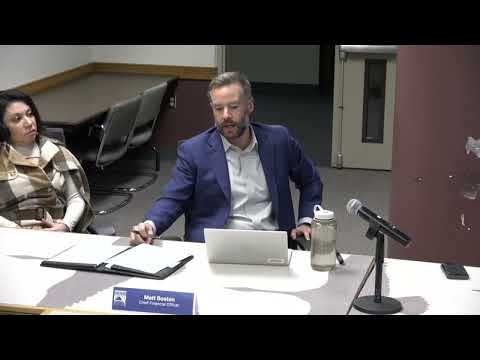
Spokane City Council and city executive staff used a study session to outline a calendar and staff workplan for the 2025–26 biennial budget, highlighting steps the administration and council expect to take on technology modernization, property use, retirement funding and collective bargaining costs.
Mayor and administration staff framed the session as a planning discussion for the biennial budget, asking council members to identify topics to explore at upcoming committee and study meetings. Finance staff said they will present a March update on property evaluation and a financial “road map,” followed by discussions through the year on capital planning, an enterprise resource planning (ERP) project, the Spokane Internal Lending Program (SILP), and biennial budget adjustments.
The session covered several areas city leaders said are priorities for 2025: an external real‑estate adviser and a Robert Wood Johnson Foundation–funded “Putting Assets to Work” effort to review underused city properties; a 2–4 year ERP implementation planning timeline with a 12–24 month general ledger cleanup; and an evaluation of the Spokane Employees’ Retirement System (SERS) and other city retirement obligations. Staff also discussed capital improvement planning, upgrades to the Questica budget software, and the internal lending program that funds police and fire capital purchases.
Council members and staff debated timing for the mid‑biennial budget modification. The administration noted a discrepancy between the city’s Spokane Municipal Code language and the Revised Code of Washington (RCW): under current local code the modification timeline references an 8‑month delay and a November council meeting, while the RCW window runs from Sept. 1 to Dec. 31. Staff said an early November ordinance date would reduce the amount of revenue and tax data available when the council must act and suggested that the council consider aligning practice with the RCW or targeting early December for passage to allow fuller revenue information.
Retirement and personnel costs drew sustained attention. Staff said SERS had an unfunded liability in the “close to $300,000,000” range and noted that employer and employee contribution rates had reached about 11.25 percent, which staff and council members described as a recruiting and retention constraint for entry‑level positions. The administration said some retirement plan performance looked stronger in 2024 but recommended a holistic review of the city’s retirement obligations and reported the mayor added two seats to the retirement board — one union and one mayoral representative — to improve oversight.
Collective bargaining agreements and rising personnel costs were presented as the primary drivers of expenditure growth. Staff summarized recent contract provisions for multiple bargaining units, noting multi‑year pay steps and specialty pays that have increased overall compensation costs; they said personnel costs in the general fund rose faster than revenue over the last several years, and that keeping total compensation growth at or below revenue growth will be critical for long‑term fiscal sustainability.
On capital and investments, staff said the city has an investment pool and short‑term lending program (SILP) that support police and fire purchases and that the SILP cap is linked to a portion of the Spokane investment pool (staff cited a 15 percent threshold in current practice). Staff also listed upcoming calendar items: a January kickoff for the capital improvement program (CIP) and integrated capital work, a March review of a six‑year street CIP, September–November work on biennial adjustments, and an encumbrance carryover process beginning Jan. 17.
Council members requested additional educational briefings and more frequent updates on several subjects: membership and role of the city’s investment board; enterprise fund performance and contributions to the general fund; staffing levels and telework usage; annexation fiscal impacts; and facility issues including municipal court space and a memorandum of understanding with the county about shared facilities. Members also asked for a briefing on the city’s AI use policy and on HR metrics such as retirement eligibility and recruitment/retention indicators.
No formal actions or votes were taken at the study session; the meeting was described by staff and council members as preparatory work to structure future committee agendas and the March follow‑up study session. Staff said they will return with more detailed materials and recommended timelines for the ERP road map, the property‑portfolio analysis, retirement review, and the biennial modification schedule.
Ending: The mayor and council scheduled follow‑up discussion in March and agreed to fold some topics into committee meetings over the next several months. The session closed with the administration thanking council and staff for their work on the biennial budget.