Get Full Government Meeting Transcripts, Videos, & Alerts Forever!
Get email alerts on the Urban Design topic
No spam. Unsubscribe anytime.
Resident urges Titusville to favor dense, walkable downtown development over sprawl
Summary
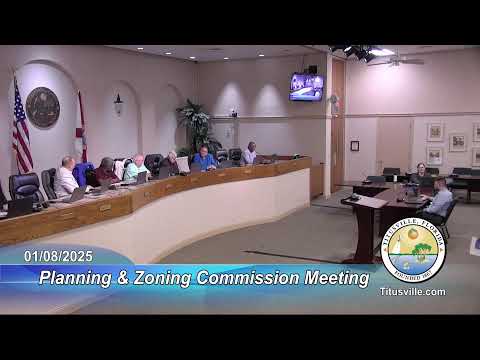
During public comment at the Jan. 8 meeting, resident Laurie Thompson presented research from 1,000 Friends of Florida recommending denser, walkable mixed-use development to improve fiscal sustainability and urged the commission and council to use recent community engagement reports to guide comp-plan changes.
Laurie Thompson, a Titusville resident and local business owner, told the Planning and Zoning Commission on Jan. 8 that research and examples show dense, walkable mixed-use development produces more tax revenue per acre and can help local governments pay for infrastructure that sprawling, single-family development does not cover.
Thompson cited a report prepared for 1,000 Friends of Florida that, she said, found many U.S. communities struggle to afford essential infrastructure because low-density suburban development “does not produce enough tax revenue to pay for its infrastructure liabilities.” She urged the commission to consider downtown-focused redevelopment and to use recent public-engagement work — a Titusville Natural Resources public-engagement summary and recommended strategies prepared by Inspire Place Making Collective — when discussing changes to the comprehensive plan.
“Dense walkable mixed use development patterns produce far more tax revenue per acre than is needed to pay for their infrastructure,” Thompson said, adding that downtown redevelopment can help subsidize infrastructure in lower-density parts of the city. She told commissioners that Titusville has a number of empty lots downtown and areas west of the railroad that present an opportunity for a different development pattern than the post-1960s sprawl that followed the arrival of the space center.
Commissioners thanked Thompson and discussed ways to distribute the report to neighborhoods that may resist denser development, particularly residents west of the railroad tracks. Thompson said she had printed 40 copies of the report and would provide more and that the Planning and Zoning Commission could place the report on a future agenda for discussion. One commissioner also recommended members and council review 1,000 Friends of Florida’s online presentation on the findings.
Thompson also referenced other case studies, such as a linear-park transit project in Miami, as design examples. She noted that protecting wetlands and natural resources must be part of any development conversation; she said some wetlands are costly or impractical to develop and that those natural assets provide stormwater filtration functions.
The commission did not take action on Thompson’s comments at the meeting; commissioners indicated they would consider placing the material on a future agenda and that the applicant’s materials and the Inspire Place Making Collective report would be available for commission review.