Get Full Government Meeting Transcripts, Videos, & Alerts Forever!
Get email alerts on the Comprehensive Plan topic
No spam. Unsubscribe anytime.
Eugene launches Phase 2 of Envision Eugene; UGB study and housing goals targeted for 2026 adoption
Summary
City of Eugene staff released a recorded presentation outlining Phase 2 of the Envision Eugene comprehensive plan. The work will draft new chapters on housing, land use and public facilities, study whether the urban growth boundary (UGB) must expand, and seek community input through surveys and advisory groups ahead of a 2026 adoption process.
Stuart Warren, an associate planner on the City of Eugene community planning and design team, released a recorded presentation launching Phase 2 of the Envision Eugene comprehensive plan and the Urban Growth Strategies work.
Warren said the project will produce “updates to the comprehensive plan, other adopted city plans and land use regulations, a parcel specific land use designation map, and an evaluation of whether there is a need to expand the urban growth boundary or UGB.”
Phase 2 will draft chapters on community engagement, compact development, housing, community health, public facilities and services, and land use, and is scheduled for completion in 2026 when the Eugene City Council and the Lane County Board of Commissioners will consider adoption. Warren said the project was initiated in January 2024 and that the Planning Commission approved the community engagement plan in February 2024.
The work is part of a larger Urban Growth Strategies program that Warren described as “1 component of Urban Growth Strategies, which will identify the tools, actions, policies, and land needed for the next 20 years for living wage jobs and housing that everyone can afford.” He told viewers the project team will release a series of surveys on the Engage Eugene webpage and that those surveys “will be open until the end of July.”
Warren explained how the Envision Eugene vision and adopted pillars feed the comprehensive plan. He said Phase 1, adopted in 2017, established Eugene’s current UGB and contained chapters on economic development, transportation, administration and implementation, and the UGB; appendices included a map of the UGB and two land supply studies. The Phase 1 UGB map, Warren said, “established Eugene specific UGB and is our current boundary for which we plan for growth” and provided a land supply for the 2012–2032 planning period.
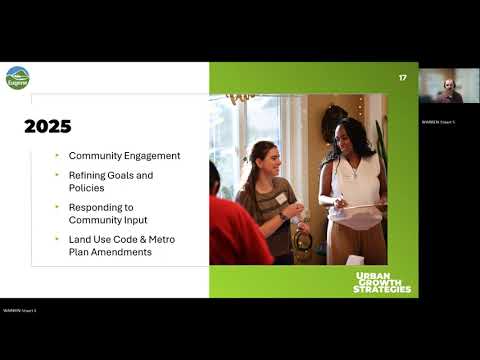
The Phase 2 land use chapter will include a parcel-specific land use designation map to replace the metro plan diagram within Eugene’s UGB. Warren said staff will use community input, research into other cities’ comprehensive plans, and internal collaboration to draft goals and policies. He listed planned engagement activities in 2025 that include work with a housing and developer working group, an equity advisory panel, the Eugene Planning Commission, City Council, the Lane County Planning Commission, and the Lane County Board of Commissioners.
Warren placed the state planning framework in context, noting Oregon’s statewide planning system was established by Senate Bill 100 in 1973 and that Oregon maintains 19 statewide planning goals. He also said House Bill 3337 required Eugene and Springfield to create their own local comprehensive plans and UGBs in 2007.
Warren closed the presentation with instructions for public participation: videos and surveys for each draft chapter will be posted on the project webpage and the Engage Eugene page, and staff email contact information will be available. He encouraged viewers to take the surveys and provide input.
Next steps listed in the presentation include continued public engagement in 2025, drafting land use code and metro plan amendments, finalizing draft chapters and preparing an adoption package, and formal public hearings with the Planning Commission, City Council and Lane County decision-makers in 2026.