Get Full Government Meeting Transcripts, Videos, & Alerts Forever!
Get email alerts on the Transportation Funding topic
No spam. Unsubscribe anytime.
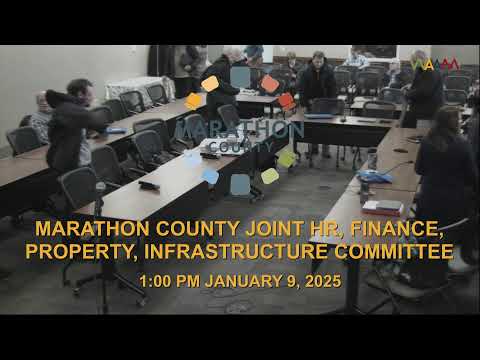
Marathon County committees hear warnings on road-funding gap, pause $30 million shop allocation
Summary
Marathon County committees received reports showing a growing mismatch between transportation needs and dedicated revenue and asked staff to prepare a public summary before the full county board considers any major financial moves.
Marathon County committees received reports showing a growing mismatch between transportation needs and dedicated revenue and asked staff to prepare a public summary before the full county board considers any major financial moves.
Debbie Jackson, executive director of the Wisconsin Transportation Development Association, told the joint Infrastructure and Human Resources, Finance and Property committees that Wisconsin largely funds roads with “fixed flat fees that are not keeping up with the needs of our aging infrastructure system,” citing the per-gallon gas tax and per-vehicle registration charges as revenue sources that do not automatically rise with inflation. “I think we're in a situation that we probably need more money just to maintain the system conditions we've got,” Jackson said.
The committees heard a technical county-level analysis from the North Central Wisconsin Regional Planning Commission and a local county 2050 highway sustainability study. Planners said Marathon County’s network is large—more than 600 miles—and that, under current revenue trajectories, the county will increasingly fall behind the funding needed to maintain its system at the board’s target PASER rating of about 7.
Why it matters
Committee members and staff framed the discussion as a planning and funding question with near-term and long-term components: (1) how existing revenue streams such as state general transportation aid (GTA), the vehicle registration fee (the county “wheel tax”), and recent one-time transfers have masked structural shortfalls; and (2) whether to use reserves or borrowing to pay for major capital steps such as a replacement highway shop that would also change operational needs.
Key findings and figures discussed
- Jackson summarized statewide context: the state budget includes roughly $750,000,000 of general-fund support for transportation in the current biennium, including about $550,000,000 in one-time funds; a transfer of EV sales-tax receipts was estimated near $100,000,000 in the budget referenced in the discussion. She warned the federal Infrastructure Investment and Jobs Act funding will be reauthorized in 2026 and that its future level is not certain.
- Committee planners said Marathon County’s system exceeds 600 miles and that projected investment shortfalls widen over five-year intervals unless revenue is increased or the system is reduced.
- The committee discussed recent local numbers: a county highway reserve that at one point was reported in audit summaries as roughly $49,000,000 (2019 to 2023 comparisons were cited), later reported as about $43,000,000 after 2024 activity and budget actions; staff said the most recent working estimate of truly unassigned funds is about $41,000,000 (audited and post‑audit adjustments were noted as pending). Committee members emphasized those reserve figures reflect prior years’ federal and state inflows and underspending on some budgeted items, and that board actions have already drawn on reserves in adopted budgets.
- On electric vehicles and hybrids, committee members cited the TDA report that hybrids were modeled as paying an additional roughly $75 annually and battery-electric vehicles an additional roughly $260 annually in registration charges in the report’s scenarios; committee staff also noted a new public-charging kilowatt charge that started January 1, 2025, and was described in the meeting as a charge of about 3¢ per kilowatt of electricity sold at public chargers, with the proceeds directed to the state transportation fund.
Discussion highlights
- Planners and highway staff emphasized trade-offs: letting the system degrade, reducing the county’s network size (for example through jurisdictional transfers to municipalities), or increasing revenue. The planning study noted limited opportunities in Marathon County to substantially shrink the county highway network because many miles are rural county highways.
- Highway staff described asset-tracking work already under way: more frequent PASER condition reporting, a culvert inventory and inspections program, and a planned asset-management rollout using the vendor "Cartagraft" and state HIS system entries for culverts.
- Supervisors raised equity and communication issues about the wheel tax (vehicle registration fee) and whether it is a “user fee” or a tax; several supervisors urged better public-facing materials explaining options and trade-offs (levy, registration fee, bonding, or service-level reductions). The county’s green-book benchmarking showed Marathon County on the low end of per-capita highway spending while operating one of the largest lane-mile systems in the state, a fact several supervisors said should be communicated to residents.
Action and next steps
Chair Terry Gibbs moved that the committees “assign $30,000,000 out of the highway reserve fund for the future construction of the highway shop, and direct staff to provide a full board presentation on the steps taken in the past and efforts that are relevant to the relocation of the highway shop and provide that information in an educational session to the board in the March 2025 education meeting.” The motion received a second but was withdrawn by the maker amid requests for more detail on site, cost estimates and timing.
Instead of the assignment, committee members directed staff to prepare a concise, public-facing summary (frequently asked questions/one- to two-page briefing) explaining: the county’s funding options (registration fee, levy via bonding, or service-level reductions), how reserves have grown and been used, the highway shop concept and potential efficiencies, and possible timeline and cost ranges. Staff said they would return with updated reserve numbers, project lists, and a March presentation for the full county board’s educational meeting.
Votes at a glance
- Motion to assign $30,000,000 from the highway reserve to a new highway shop (moved by Chair Terry Gibbs; seconded by Supervisor Hart): withdrawn; no final vote taken.
- Adjournment, Finance/HR committee: moved by Supervisor Hart; seconded by Supervisor Lemmer; outcome: approved (ayes recorded). Adjournment, Infrastructure committee: moved by Supervisor Soybert; seconded by Supervisor Judson; outcome: approved (ayes recorded).
Who spoke
Speakers quoted in this article are those who appear in the meeting transcript: Debbie Jackson (executive director, Wisconsin TDA), Chair Terry Gibbs (committee chair), Jim (highway commissioner, Marathon County), representatives from the North Central Wisconsin Regional Planning Commission (Dennis, Lawrence, Daryl), Administrator Leonard (county administration), and multiple Marathon County supervisors (including Supervisors Lemmer, Marshall, Pool, Hart, Hartinger, Soybert, Janssen, Gesselman, Seibert). All direct quotes in this article are attributed to speakers as recorded in the meeting transcript.
Ending
Committee members asked staff for a short public summary and timeline to allow the full county board and residents to weigh funding options before any formal allocation. Staff committed to updated reserve figures, project lists and an educational presentation at the county board meeting in March 2025.