Get Full Government Meeting Transcripts, Videos, & Alerts Forever!
Get email alerts on the Irrigation District Finance topic
No spam. Unsubscribe anytime.
Okanogan County tells Aeneas/"Enia Slate" irrigation district to end use of registered warrants by Dec. 31, 2025
Summary
County treasurer and staff pressed the Aeneas/Enia Slate irrigation district to stop relying on registered warrants, set a Dec. 31, 2025 target to come off warrants, and outlined options including rate increases, grants and loans to cover a roughly $200,000 project and long-term solvency needs.
Okanogan County Treasurer Pam Johnson told representatives of the Aeneas (referenced in the record as “Enia Slate”) irrigation district that the county will not treat registered warrants as an open-ended funding source and has set December 31, 2025 as the deadline for the district to come off registered warrants.
Johnson said the district was given three years after first moving to registered warrants in 2021 and that “that 3 years ended December 31, 2024” and that the county extended the arrangement for one additional year: “So there is an end date of December 31, 2025 to be off of register warrants.”
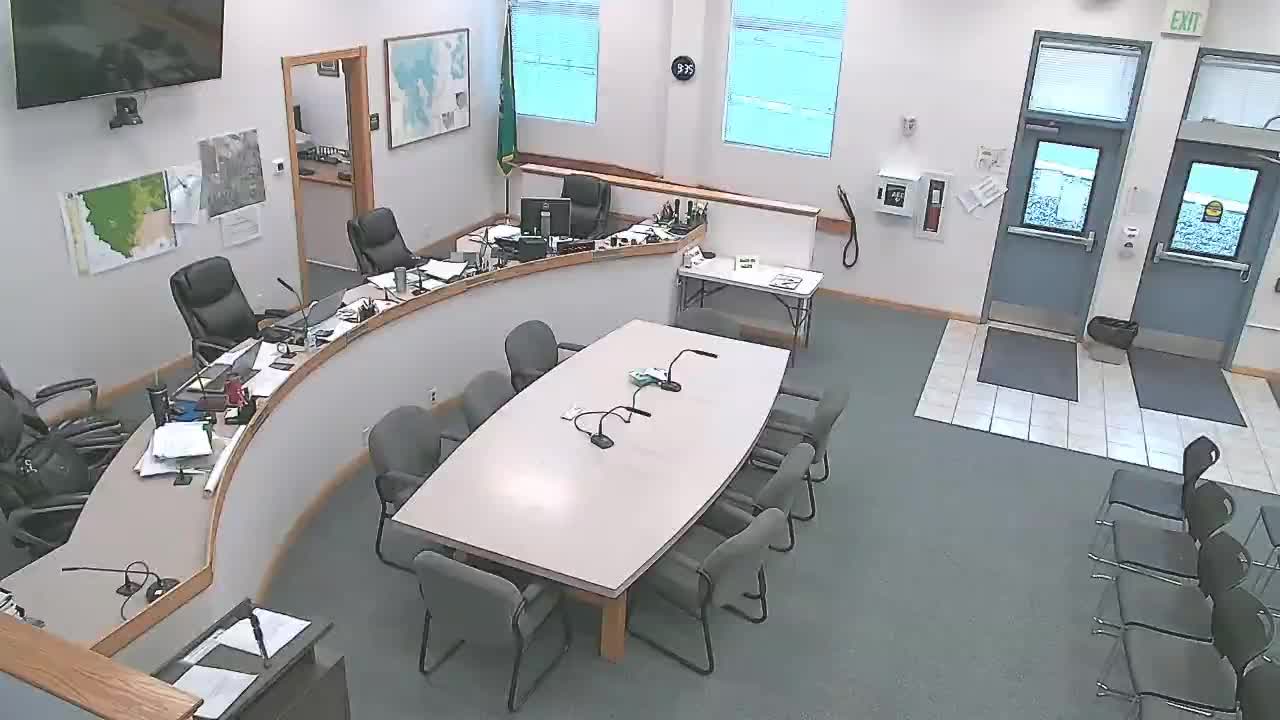
The discussion, at a Finance Committee meeting that included county auditors and district board members, focused on how the district can reach solvency without continuing to draw on other local governments’ pooled funds. Irrigation officials warned that without the district in operation some private wells and wells that support ranching and orchards could run dry. Jack Denison, who identified himself as the district board chair, described efforts to reduce debt and to pursue projects intended to reduce operating costs.
Why it matters: registered warrants are effectively short-term IOUs that use other entities’ pooled cash to meet district obligations. County staff said the practice poses a fiscal risk to other depositors if warrants are relied on indefinitely. The county’s direction makes a deadline and pushes the district to identify revenue or outside funding to cover operations and repairs.
Most important facts
- The county says the irrigation district was allowed to use registered warrants (a limited, temporary authority) starting in 2021 and the county set an explicit end date of Dec. 31, 2025.
- The district’s most recent reported outstanding shortfall was cited at about $66,000; the district’s board and county staff discussed a proposed capital project with an earlier bid “just under $200,000.” County staff estimated a 25% cost-share would be roughly $50,000.
- District leaders reported current assessed charges at about $3.80 per acre and told county staff the district contains roughly 1,164 irrigable acres. County staff and outside advisors told the board the district likely must raise rates substantially (one staff estimate discussed raising rates toward the $400–$450 per-acre range) to cover operations and build reserves if it cannot secure outside grant or loan funds.
- County staff placed a temporary administrative hold on issuing any additional registered warrants for the district until the district returns a signed registered-warrant policy to the treasurer’s office.
Discussion and options considered
County staff and the district discussed multiple paths to solvency:
- Rate adjustments and a structured resolution. County staff explained the district’s status as an assessment (not a taxing) district and described how the board could certify new rates to the treasurer for a supplemental tax-roll correction if the district votes to raise assessments midyear. Treasurer Johnson suggested writing a resolution that specified an amount and a time-limited term (for example, a multi-year increase tied to a project) so that members would know the duration of any increase.
- Grants and cost-share programs. District members reported pending applications to the Natural Resources Conservation Service (NRCS) and WaterSmart, and said NRCS could fund 50–75% of a pump/VFD upgrade project; the district was revising scopes and expected an outcome by end of March for one application. County staff also recommended contacting the Department of Ecology and the State Treasurer’s local program and suggested the district might qualify for a 0% loan from Ecology for capital projects.
- Loans for capital projects. County staff said state loan programs or bank financing might be possible for a definable capital project (as opposed to borrowing against cash-flow shortfalls). Staff cautioned commercial lenders will not make loans to cover ongoing registered-warrant deficits but may consider loans tied to a revenue-backed project.
- Nonpaying users and enforcement. The board described habitual delinquents and explained how foreclosure after three years is statutorily available; the treasurer noted RCW procedures require a three-year process before those assessments go to foreclosure. County staff discussed options to physically lock or isolate turnouts but said retrofitting laterals and valves could be a costly capital project (staff gave a rough estimate of at least $50,000 to install remote lockout capability for every turnout).
Quotes
“That 3 years ended December 31, 2024. You did not come off of register warrants at that time. So we extended it for 1 year for you to come off of register warrants… There is an end date of December 31, 2025 to be off of register warrants,” Pam Johnson, Okanogan County Treasurer, said during the meeting.
“We are working diligently to do what we need to do… we keep running into some dead end roads,” Jack Denison, board chair for the irrigation district, said, describing attempts to find funding and reduce debt.
Next steps and immediate directions
- Treasurer Johnson told the district she will not issue additional registered warrants until the district returns a signed registered-warrant policy to the treasurer’s office.
- The district agreed to pursue updated project cost estimates and to prepare a budget/resolution showing how a rate increase would be structured (term, per-acre amount and expected annual revenue) so the county can evaluate whether the district will be solvent by the end of 2025.
- County staff offered to contact state program contacts, including Ecology and the State Treasurer’s local program, and to meet with the district again at the end of March to review progress.
Background
County staff outlined that registered warrants are an emergency/temporary financing practice and that continuing to rely on pooled funds exposes other depositors (schools, taxing districts) to liquidity risk. The district and county also discussed water-level and habitat issues: the irrigation system supports local wells, ranching and public-access lakes, and state wildlife agencies have raised concerns about maintaining lake levels.
Ending
District representatives said they will pursue grant/loan options and prepare a formal rate-resolution if needed. County staff said it will re-evaluate the district’s status after the district provides the requested policy and updated cost/revenue materials.