Get Full Government Meeting Transcripts, Videos, & Alerts Forever!
Get email alerts on the Land Use Rezoning topic
No spam. Unsubscribe anytime.
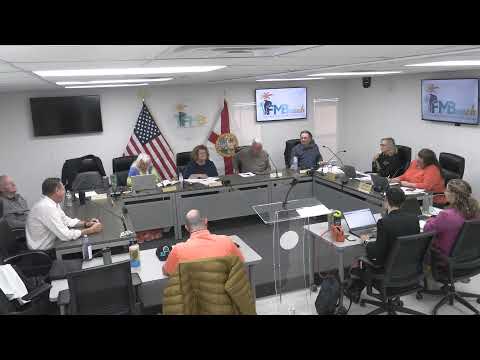
Fort Myers Beach hearing on food-truck park rezoning draws hours of debate; council hearing set for Feb. 11
Summary
The Local Planning Agency voted Jan. 9 to expand the boundary of an existing Commercial Planned Development on Estero Boulevard but continued consideration of a proposed food-truck park and commercial parking lot to Feb. 11 for further study and refined conditions.
The Local Planning Agency on Jan. 9 voted to recommend expanding the boundary of an existing Commercial Planned Development (CPD) that covers parcels on Estero Boulevard, but it deferred a separate rezoning and detailed approval for a proposed food-truck park and commercial parking lot until a Feb. 11 council hearing.
The town’s principal planner, Judith Frankel, told the agency the CPD expansion (agenda item B) would add two adjacent parcels acquired by the applicant to a 2007 CPD approved by resolution 07-28. Frankel said the expansion itself raised no conflicts with the comprehensive plan but that the applicant’s proposed new schedule of uses and a master concept plan for the food-truck park would replace the older CPD document if adopted.
Applicant representatives and property owners — including Ken Galander of Neighborhood Company and owners Jamie and Debbie Hotka and Dan Myers — presented a master concept plan for a roughly 0.7-acre site at beach access 26. Their proposal calls for a minimum of five vendor pads served by a new “park support” building with restrooms, beverage service (beer and wine only), storage and staff space. The project includes a commercial parking lot intended to be paid parking, landscaping and stormwater work and utilities hookups to serve vendors. Engineer Brandon Frey and other consultants were on the team to answer technical questions.
Town staff and the applicant described a long set of conditions intended to limit noise, hours of operation and uses, require utility hookups for vendors, and set landscaping, buffering and stormwater requirements. Frankel and senior planner Jason Smalley also laid out deviations the applicant asked to permit — including surfacing options for the parking lot — and told the LPA those deviations were the basis for several requested variances.
The LPA spent more than an hour questioning the applicants on parking logistics — whether vendor patron parking would be dedicated, how paid parking would be enforced, and what would happen when the lot filled during peak beach hours. Several commissioners pressed whether the proposal would reserve a number of spaces exclusively for the vendors versus operate as a general paid lot for beachgoers. Applicant spokespeople said parking could be administered by lease or operator control and proposed that some spaces could be reserved for vendors by contract; staff asked for a clearer, site-wide parking calculation before final town-council action.
Public comment was extensive. Neighbors from Cottage Avenue and Pelican Watch described tight streets, frequent on‑street parking, security and noise concerns, and urged stricter limits on hours and on overnight parking in a gated lot. Several speakers asked for stronger buffers and recommended a permanent enclosed building rather than mobile trailers. The applicants said they sought to create a family-oriented, incubator-style food park with restrooms, bike racks and children’s activities and that they had modeled many conditions on rules used in Bonita Springs, Cape Coral and Fort Myers.
After discussion, the LPA approved the CPD boundary expansion unanimously so the two additional parcels would be included in the existing CPD. On the separate rezoning and conditions for the food-truck park, the LPA did not vote to recommend approval and instead continued the matter to the next LPA meeting and the town-council hearing; staff set the continued hearing for Feb. 11 at 9:00 a.m. The continuance gives staff, the applicant and neighborhood representatives time to refine parking calculations, hours-of-operation restrictions, and the wording of the conditions.
Why this matters: The hearing tested how Fort Myers Beach will regulate a relatively new land use — a permanent food-truck park combined with paid commercial parking — on fragile, redeveloping oceanfront parcels. The LPA and public both cited tensions between visitor parking demand and neighborhood livability; the additional review time gives staff and applicants a chance to translate the concepts discussed into precise enforceable conditions the town can use either in this case or as a template for future proposals.
What’s next: The CPD boundary expansion moves forward as recommended to the town council. The rezoning and project-specific conditions for the food-truck park will return for further review at the town-council hearing on Feb. 11 and to the LPA for a recommendation. If the council takes up the item, it will consider the ordinance and the final conditions staff and the applicant frame after the LPA’s continued review.