Get Full Government Meeting Transcripts, Videos, & Alerts Forever!
Get email alerts on the Water Quality topic
No spam. Unsubscribe anytime.
Advisory committee reviews rural water-quality report, recommends board review after note on chlorides
Summary
A Sustainable Management Criteria Technical Advisory Committee meeting included a presentation of a rural water‑quality report showing recurring high levels of nitrate, chloride, total dissolved solids and detections of 1,2,3‑TCP near Greenfield City and elsewhere in the Salinas Valley.
A Sustainable Management Criteria Technical Advisory Committee meeting included a presentation of a rural water‑quality report showing recurring high levels of nitrate, chloride, total dissolved solids and detections of 1,2,3‑TCP near Greenfield City and elsewhere in the Salinas Valley.
The report showed what the presenter called "a hotter spot around the city of Greenfield" in maps compiled from multiple databases and an updated map using data since 2013. The presenter said nitrate concentrations appeared higher in more recent samples and offered a possible explanation: "the nitrate is gonna be coming from from fertilizers almost entirely," and there can be a decades‑long lag between fertilizer application and deeper aquifer detections.
Why it matters: committee members flagged public‑health and supply implications. The report identified 1,2,3‑TCP — a breakdown product of an older fumigant — as a concern because the state set a maximum contaminant level (MCL) for it in 2017 that is near analytical detection limits. The presenter said about the 123‑TCP results: "in the last couple of years, they've sampled about 200 wells in the area. These dots on the map are, the 30 or so wells where it was detected." Nearly all reported detections were at or above the MCL, which the presenter characterized as a primary health violation in the affected management area.
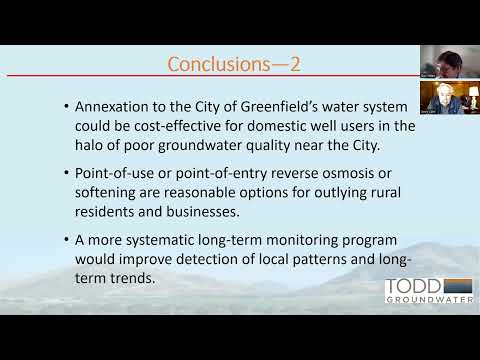
Key findings and discussion - Spatial pattern: Maps showed lower‑contaminant (dilute) groundwater along a band near the western foothills and elevated concentrations — nitrate, chloride, TDS and 123‑TCP — clustered near Greenfield City and in places upvalley. The presenter noted a prominent 123‑TCP detection near an unregulated county dump in one figure. - Trends: Nitrate was the only constituent with a visible increasing trend in the dataset; the presenter cautioned that changes in monitoring intensity could affect apparent trends and said the lag time from surface fertilizer application to appearance in deeper aquifers can be on the order of 50 years. - Sampling: The presenter said the study combined data from multiple monitoring programs and years and recommended a more systematic, long‑term monitoring program to improve trend analysis. - Sources and causes: Committee members and the presenter distinguished naturally occurring salts (chloride, TDS, sulfate, hardness, boron and some metals) from anthropogenic contaminants. The presenter said, "Nitrate, on the other hand, is gonna be almost entirely of human source and certainly all the 1, 2, 3, TCP... will not occur in nature."
Options discussed - Consolidation: One management option discussed was connecting some rural domestic wells to municipal distribution near Greenfield City where water quality is regulated; the presenter cautioned that pipelines are expensive and there are institutional issues (for example, LAFCO and city–county cooperation) to resolve. - Treatment: For isolated domestic wells, participants discussed point‑of‑use or point‑of‑entry treatment. The presenter cited reverse‑osmosis systems as effective for removing most constituents and noted under‑counter units can supply a single tap for drinking. - Monitoring and planning: Committee members asked for clearer distinctions between naturally occurring salinity (including influence from marine formations and evaporative concentration from irrigation) and coastal saltwater intrusion. The presenter agreed to add a clarifying sentence stating the chloride/TDS patterns observed in the study area are not evidence of coastal saltwater intrusion.
Committee action Staff asked the advisory committee to recommend that the board of directors approve the rural water‑quality report with an added note clarifying that elevated chlorides in the study area do not indicate coastal saltwater intrusion. A motion to recommend board approval with that addition was made and seconded; committee members proceeded to a roll call for the hybrid meeting. The transcript does not include the roll‑call tally or a recorded final vote result.
Community input and next steps A local business owner, Jerry Lohr, representing a winery in the area, said he would follow up with the committee about the winery's current water‑treatment practices. Committee members emphasized the need for further analysis stratified by well depth and well type, additional investigation of the prominent 123‑TCP detection near an old dump, and the development of a systematic long‑term monitoring program to reduce uncertainties.
The meeting record shows a quorum was present after the addition of one member and the advisory committee moved on after approving the recommendation for the board to review the report with the added clarification. The committee also noted this item as the single action on the agenda and directed staff to prepare materials for the board of directors.