Get Full Government Meeting Transcripts, Videos, & Alerts Forever!
Get email alerts on the Land Use Development topic
No spam. Unsubscribe anytime.
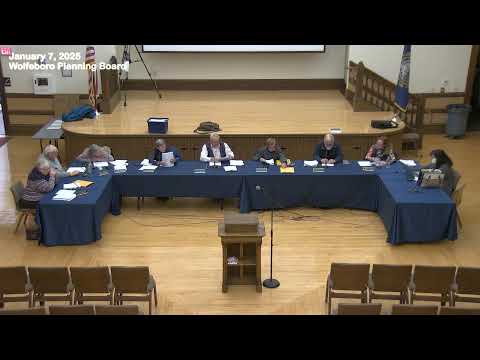
Planning board approves Hancock Lumber special use permit and site plan with conditions after neighbors raise trash and drainage concerns
Summary
Wolfeboro Planning Board approved a special use permit and site plan for Hancock Lumber’s improvements at 100 Pine Hill Road, imposing conditions including stormwater maintenance, parking striping, marked dumpster location and invasive-soil handling after public comment about litter, fencing and wetlands.
The Wolfeboro Planning Board on the meeting considered and approved a special use permit and a site plan for Hancock Lumber’s expansion and site improvements at 100 Pine Hill Road, including stormwater upgrades that impact the 25-foot wetland buffer and covered outdoor storage structures.
The approvals follow a public hearing in which nearby residents urged the company to address blowing trash, a deteriorated chain‑link fence and invasive Japanese knotweed along the property edge. Henry Hess of Sebago Technics, representing Hancock Lumber, told the board the project replaces a failing on‑site storm drain, adds a proprietary stormwater filter and detention system, and would outlet treated water back into the existing drainage channel. He said the proposed storm filter reduces total suspended solids by about 85%, phosphorus by about 75% and nitrogen by about 50%.
The board’s action included two formal steps. Members first voted to accept the special use permit application as complete and then approved the special use permit (Case 2025‑02) after hearing the project presentation and conservation‑commission review. The board then accepted the site‑plan application as complete and approved the site plan subject to conditions that planners and the town engineer recommended.
Why it matters: The project proposes to treat and re‑route existing site runoff into a rehabilitated channel and to add covered lumber storage and a partially enclosed pole barn. Neighbors said they sought protections for visual screening, litter control and drainage to ensure wetlands and adjacent yards are not further degraded.
Key details: The approval and conditions the board attached include: a requirement to implement the submitted stormwater treatment (a proprietary “jellyfish” filter and detention area) and provide a manufacturer‑specific annual maintenance plan and annual maintenance log to the planning department; removal, loaming and seeding of specified existing gravel areas to return them to pervious surface; provision of flared ends for proposed pipe inlets and outlets; completion of test pits before building permits are issued to verify subsurface conditions; monumentation of wetland edges within 90 days of construction completion; an erosion‑control sequence and inspection before construction; handling and disposal procedures for soils containing invasive species (Japanese knotweed); and showing and striping 24 parking spaces, location(s) for on‑site dumpster(s) on the final plan, and additional landscaping/screening along the frontage as part of final plan submittal.
During the public comment period, Sandra Snyder (94 Pine Hill Road) and Judith Gooding Morrison (95 Pine Hill Road) described windblown strapping, foam and paper that have blown onto their yards and asked for a taller, opaque screen along the frontage. Several speakers described a degraded culvert and sedimented channel; Hess said replacing the crushed storm pipe should improve flow and water quality. Board members and the conservation commission expressed that the plan, as revised and reviewed by third‑party engineering (Ty and Bond), reduces detrimental impact on wetlands compared with current site conditions.
Board direction and conditions: The board adopted the planner’s recommended list of pre‑ and post‑construction conditions and added a requirement that soils containing invasives be handled to prevent spread. The board also asked the applicant to show dumpster location(s) and parking striping on the final plan and to submit final lighting specifications confirming dark‑sky‑compliant fixtures. The special use permit was made valid for one year and the applicant must record required documents at the Carroll County Registry of Deeds and provide as‑built plans electronically when construction is finished.
What was not decided: Neighbors asked for a solid wood fence and additional long‑term landscape work along the frontage. The board did not require full frontage reconstruction as part of this approval but made screening, dumpster placement and additional landscaping conditions prior to final signature so the board and staff can review those final design details.
Quotes: “The proposed activity will have no negative environmental impact to abutting or downstream property in the hydrologically connected water or wetlands resources,” Henry Hess said, describing the treatment and detention system. “We understand it’s an invasive or obnoxious weed, that does deserve to be treated as such,” Hess said about Japanese knotweed and said the project team would work with state resources for proper disposal.
Ending: With the conditions in place, the planning board found the application conforms to the town’s ordinances and voted in favor of both the special use permit and the site‑plan approval. The project still requires final plan signing, recording, and permit checks by the town before construction begins, and staff will receive the maintenance logs and as‑built plans required by the approval.