Get Full Government Meeting Transcripts, Videos, & Alerts Forever!
Get email alerts on the Elections topic
No spam. Unsubscribe anytime.
Utah GOP chair urges party unity, defends caucus path and outlines outreach after SB 54 constraints
Summary
Rob Upton, chair of the Utah Republican Party, told the Washington County Republican Women the party will prioritize caucus engagement, legislative changes to voter-record rules and targeted out-of-state outreach after the limits imposed by SB 54 and recent legal decisions.
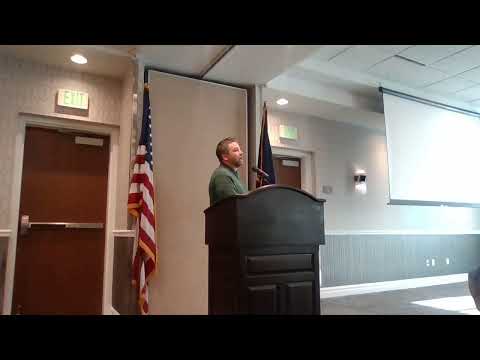
Rob Upton, chair of the Utah Republican Party, told the Washington County Republican Women during their meeting in St. George that the party will keep pushing the caucus-convention process while working within state law and pursuing legislative fixes on voter-record transparency.
The remarks, delivered during a wide-ranging speech and Q&A, stressed several operational priorities: restoring broader caucus participation, changing state rules that allow a portion of voter records to be withheld from party access, supporting convention winners through the primary when possible, and deploying resources to neighboring battleground states. "We were able to raise and deploy over a $100,000 in resources to Arizona and Nevada engaging with Republican voters," Upton said.
Upton framed the party's options as constrained by current state law, citing Senate Bill 54. He told members that SB 54 compels parties to accept primary results "regardless of the path to which the candidate qualified for that primary," and that the party previously litigated and lost on this point. "Prior to the primary, we were very supportive of our convention winners. And after the primary, we were committed to our Republican nominees," he said, explaining the legal limits on the party's authority.
Why it matters: Upton said the combination of state statutes and administrative practice has reduced the party's ability to verify signatures and to reach some members. He and several questioners flagged a related issue: a provision or administrative policy that permits individuals to place a "withheld" or private status on their voter record. Upton said that translates into roughly "35 to 40%" of Republican members whose identities the party cannot see, and he identified changing that law as a top legislative priority this session.
Upton gave several concrete operational figures during his presentation. He said the party's email list has grown from about 17,000 to roughly 120,000 addresses; the organization has raised more than $2 million since he took the chairmanship; and the state party spent roughly $150,000 to support convention winners ahead of the primary. He also reported a caucus participation rate in the 9–12% range (about 11% including attendees who did not cast presidential preference ballots) and said there are roughly 4,000 state delegates across Utah.
On strategy and tone, Upton said he prefers outreach and incentives over constant public denunciations of elected officials. "If you want them to listen when you need to complain, bring the brownies sometime," he said, urging members to reward officials who act in line with party priorities as well as criticize them when necessary.
Upton described litigation and policy work the party is pursuing outside the election window but said the party has limited options during an active campaign to avoid accusations of interfering with elections. He also noted the party itself lacks standing to re-litigate the SB 54 outcome in the same way private candidates or other aggrieved individuals might.
Upton recounted field operations as well: he said the state party raised and deployed volunteers and funds to Arizona and Nevada in 2024 and organized door-knocking trips that included youth volunteers. He described the outreach as part of a strategy to make Utah a "forward operating base" for renewing Republican strength across the Intermountain West.
Discussion vs. decisions: Much of Upton's presentation and the following Q&A were discussion and direction rather than formal action by the Washington County Republican Women. The meeting recorded no formal votes or policy adoptions on the party matters Upton described. The only formal action recorded in the meeting minutes was a motion to adjourn at the end of the session.
The meeting also included routine club business—membership counts, fundraising announcements and a Lincoln Day event pitch—but Upton's remarks were the principal substantive policy and operational discussion recorded.