Barnstable County begins public kickoff for FY26 budget, aims for "structurally balanced" plan
Loading...
Summary
County leaders opened the FY26 public budget review with a calendar of deadlines, assumptions about cost increases and a goal of avoiding reserve use by moving toward a "structurally balanced" budget.
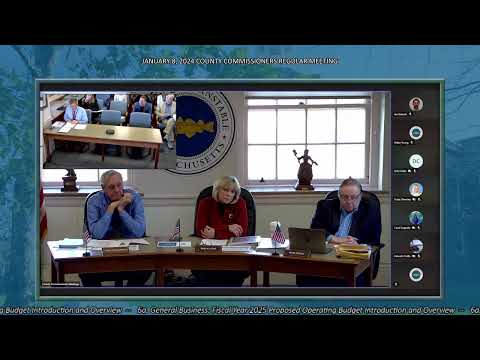
Barnstable County commissioners on Wednesday opened the public review of the fiscal year 2026 budget with staff outlining a calendar of review dates and an explicit goal to produce a "structurally balanced" budget that minimizes the use of reserves.
The presentation, delivered during the Jan. 8 meeting, mapped key dates: weekly departmental reviews leading to a commissioners' capital budget approval by Jan. 15; a Feb. 19 deadline to submit the proposed operating budget to the Assembly; an April 16 Assembly Finance Committee report; and Assembly adoption of the budget in early May. "This is sort of the traditional kickoff to the public portion of the FY26 budget," the presenter said at the start of the overview.
Why it matters: County staff said the FY26 proposal was built on conservative revenue and cost assumptions and on steps intended to limit one-time spending from showing as recurring operating revenue. The briefing included line-item assumptions for cost increases: a 3% cost-of-living adjustment, 5% for natural gas, 15% for electric, 12% for insurance and 12% for group health insurance. Staff also accounted for step increases, merit pay and anticipated retirements.
Officials noted a technical distortion in headline totals. The FY25 general-fund numbers included roughly $13.9 million of one-time funding that flowed through the general fund; by contrast the FY26 baseline that staff presented showed roughly $25.7 million in operating budget, which would appear as a 33% decline unless the one-time items are accounted for. "That's not a reduction," the presenter said. "We're more like an increase of a little over 5%."
Staff described a $1.2 million annual state reimbursement tied to sheriff's retirement assessments that will be allocated on a multi-year basis: $500,000 of that is being appropriated to the county's OPEB liability and the remaining $700,000 to a revenue stabilization fund. That 10-year reimbursement was presented as conservative one-time revenue the county is using to shore up long-term liabilities and stabilization.
Departments were instructed to submit level-services budgets that maintain FY25 staffing levels where possible and to identify recurring contractual obligations or estimate them via a three-year average when exact amounts are unknown. Commissioners and staff discussed identifying one-time capital or grant-match items explicitly in the budget book to avoid conflating one-time and recurring spending.
The presenter closed by saying the administration would return to present additional departmental budgets, including the regional commissioner's budget, the Human Rights Advisory Commission and the public safety training budget.
Ending: County officials said departmental reviews would continue in the coming weeks and staff would refine revenue and cost estimates as vendor and health-insurance numbers become final.