
Pinellas County staff outline post-disaster recovery programs; commissioners press for faster permitting and clearer appeals
Get AI-powered insights, summaries, and transcripts
Subscribe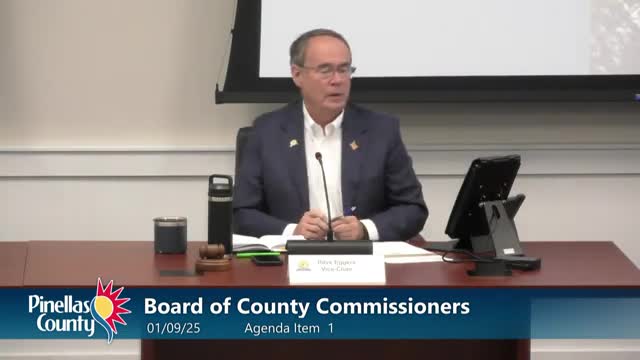
Summary
County staff briefed commissioners on federal and state recovery programs, temporary housing numbers, and a county home-repair program while commissioners raised urgent concerns about permitting delays, contractor responsiveness and insurance shortfalls for displaced residents.
Pinellas County staff briefed the Board of County Commissioners on an array of post-disaster recovery programs and preliminary funding allocations, and commissioners used the workshop to press for faster permitting, clearer appeal routes and help for residents stranded by insurance and permitting delays.
Lourdes Benedict, assistant county administrator, told commissioners the situation remains fluid and urged residents to register with FEMA even after the published deadline. “Please still go in and apply,” Benedict said, adding that FEMA has indicated it will offer a 30-day grace period for late registrants but applicants will have to document why they missed the deadline.
What county staff described
- FEMA and temporary housing: Benedict said FEMA provides up to $42,500 per household for eligible home repairs and temporary housing assistance not covered by insurance. The county presented daily-updated figures: staff said about 2,600 households in Pinellas County meet the criteria for FEMA temporary housing and that roughly 953 households had expressed they needed FEMA temporary housing and were working through the process. For FEMA- or state-leased travel trailers, staff reported 366 FEMA travel trailers approved with three placed and six in process; state travel trailer activity included 52 applications, 34 pending and seven placed. Benedict noted trailer placement is tightly regulated and trailers must be moved for incoming storms.
- Hoteling: County and state hotel programs were reported to be supporting thousands of households. Benedict said 3,338 households were in FEMA-provided hotels and another 309 households were in the state hoteling program, for a total the county estimated at about 3,600 households in temporary hotel accommodations. FEMA’s hotel assistance is typically time-limited (90 days) and Benedict urged residents to work with FEMA case managers to request extensions if they remain displaced.
- County home repair program and eligibility: The county opened a hurricane home repair application on Dec. 23. The county program offers up to $30,000 for eligible repairs not covered by insurance or FEMA, for income-qualified homeowners whose assessed property value (structure and land) does not exceed $375,000; applicants must be at or below 120% of area median income to qualify. Benedict said 481 pre-screening applications had been submitted; 45 were approved to move to the next step, and a large share of applicants were missing FEMA approval or denial letters. The county directed residents to pinellas.gov/stormrepair and a Disaster Recovery Center at the Enoch Davis Center in St. Petersburg for in-person help.
- Larger federal and state recovery funds: Benedict and other staff said the county had submitted a plan request for anticipated federal disaster appropriations and had already begun an RFP process to hire consultants to prepare the required long-term recovery plan. Staff indicated a preliminary allocation announcement included roughly $813 million at the county level (the county and municipal distribution and final award details were described as not finalized) and the City of St. Petersburg had a separate announced allocation of about $159 million. County staff planned to seek commission authority at the Jan. 28 meeting to contract with a multi-firm consultant team to administer program planning and grant management if funds are awarded.
Commissioner concerns raised in the workshop
Commissioners pressed staff on several operational issues that residents say are slowing recovery:
- Permitting and substantial-damage letters: Commissioners and residents said permit delays and the county’s process for issuing substantial-damage determinations are preventing homeowners from starting repairs. Commissioner Peters described examples where homeowners cannot secure permits even when damage and repair costs appear to fall well under thresholds. County legal staff and emergency-management staff explained the 50% substantial improvement/substantial damage rule is codified in state building code and that initial determinations are preliminary; they described an internal two-step appeal process that allows property owners to submit evidence and request a final determination or hearing officer review. Staff said the county is trying to speed reviews but noted limited inspection capacity across municipal and county offices.
- Tidal Basin contractor responsiveness: Commissioner Peters and others criticized the private contractor (Tidal Basin) that performed many initial substantial-damage assessments for not providing clear phone support and for sending letters that property owners dispute. Commissioners requested better lines of communication and asked staff to consider embedding county personnel to help clarify contractor determinations.
- Insurance and financial strain: Several commissioners relayed constituent stories about small insurance payouts, unresolved insurance disputes and mortgage companies pressing owners about repairs. Commissioner Peters said some homeowners reported receiving what they described as inadequate checks from insurers, which leaves them unable to begin repairs and facing mortgage pressure. Commissioners asked staff to document these problems for state and federal advocacy.
- Housing for people with disabilities and the Airbnb question: Commissioners asked whether FEMA or state hoteling funds could reimburse residents who secured Airbnb rentals; county staff said FEMA’s Transitional Shelter Assistance is limited to hotels and that FEMA and state programs generally do not reimburse for privately arranged Airbnb stays, which leaves some displaced residents without reimbursement options. Commissioners noted that single hotel rooms can be inadequate for households with significant disability-related needs and asked staff to pursue workarounds.
Staff direction and next steps
County staff said the next steps include completing the long-term recovery plan the county expects to submit to HUD within a 90-day window after formal award notification, standing up a consultant team to administer programs, continuing recovery support function (RSF) meetings with municipal and nonprofit partners, and actively documenting operational issues to inform state and federal advocacy. Benedict urged residents to register with FEMA and to use local Disaster Recovery Center resources for case management help.
No formal vote was taken at the workshop. Commissioners said they expect a fuller report at the commission meeting and asked staff to return with details on appeals, permitting timelines and options to accelerate safe rebuilding where legally feasible.
Ending
Staff said they will return with more detailed program guidance at the next commission meeting and recommended residents use the county recovery website and Disaster Recovery Center to get information and support. Commissioners emphasized continued outreach to state and federal partners to address insurance, contractor and permitting problems that many residents reported during the presentation.