Get Full Government Meeting Transcripts, Videos, & Alerts Forever!
Get email alerts on the Transportation topic
No spam. Unsubscribe anytime.
Puyallup council adopts 2025–2030 Six‑Year Transportation Improvement Plan
Summary
After a public hearing, the Puyallup City Council approved a resolution adopting the city's 2025'2030 Six‑Year Transportation Improvement Plan, which prioritizes road, intersection and nonmotorized projects and is intended to support grant applications for larger projects.
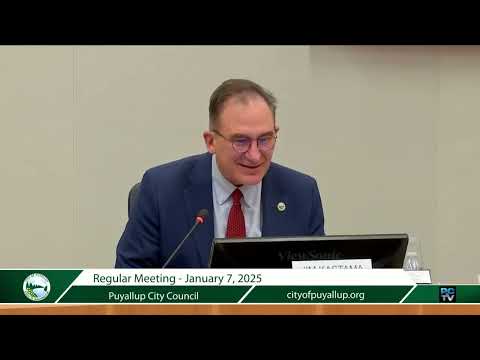
Puyallup City Council on Jan. 7 approved a resolution adopting the city's 2025'2030 Six‑Year Transportation Improvement Plan (TIP) following a public hearing and several public comments.
The plan, presented by Hans Hunger, city engineer for the city of Puyallup, lays out the city's prioritized road, intersection and nonmotorized projects for the coming years and is updated annually to align with state requirements and to support grant applications. "The adoption or the update of the 6 year transportation plan is an annual thing that we do. It's required by RCW, and it allows the city to kind of keep this document as a working document of what are the priorities focused on road projects," Hunger told the council.
Why it matters: The TIP is the city's roadmap for which road and active‑transportation projects it will seek to design, phase and fund. Because Puyallup relies heavily on grant funding for larger projects, the TIP serves as evidence of local priority when applying to state and federal programs. Councilmembers and public commenters focused on timelines for specific projects and the visibility of nonmotorized (walking/biking) elements within larger road projects.
Key details: Hunger said the TIP is aspirational and intended to show long‑range priorities that help the city compete for grants. He noted the plan does not always include utility projects even when they intersect with road work. He explained that the TIP can list projects with a nominal $1 cost when there is not yet a local funding plan, which keeps them on the radar for future grant pursuit.
During the hearing, residents raised two topics that drew council discussion. John Hopkins asked why the Riverwalk "missing link" was scheduled so far out in the TIP and urged staff to accelerate grant work. Hopkins offered that local organizations could help with fundraising and community support. Paul Romich expressed concern about the timing and level of funding shown for nonmotorized projects, noting some sidewalk and active‑transportation items appeared delayed in the schedule despite prior comp‑plan recommendations.
Council members asked staff to clarify how nonmotorized elements are shown in the TIP when they are embedded in larger road projects, such as shared‑use paths included with corridor improvements, and requested clearer tracking so constituents can see when sidewalks and bike facilities are advanced. Hunger said he could better identify the nonmotorized portion within larger projects and that timelines could accelerate if grants are secured once a project reaches a completed design and estimate stage.
Votes at a glance: The council voted by voice to approve the resolution adopting the 2025'2030 TIP. The motion was moved and seconded and passed by an affirmative voice vote. (Council present at roll call: seven members.)
Next steps: With the resolution adopted, staff said it will continue to refine project lists and cost estimates, pursue grants for shovel‑ready projects and update the TIP annually as funding and project priorities evolve.