Get Full Government Meeting Transcripts, Videos, & Alerts Forever!
Get email alerts on the Wildfire Response topic
No spam. Unsubscribe anytime.
Officials: Multiple large fires across Los Angeles County prompt evacuations, school closures, water and power disruptions
Summary
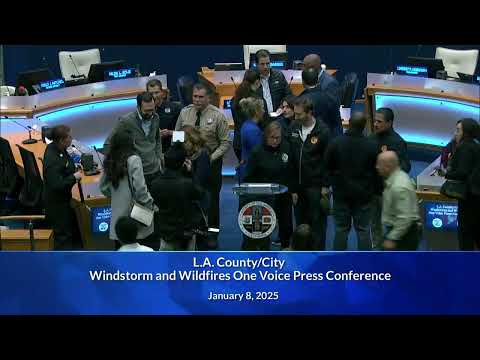
Los Angeles County and city leaders said at a joint press conference that multiple large wildfires — including fires in the Pacific Palisades, Eaton Canyon (Altadena/Pasadena area) and Sylmar — were burning across the county with little containment, prompting evacuation orders affecting tens of thousands of residents, widespread school closures and requests for statewide and out-of-state mutual aid.
Los Angeles County and city leaders said at a joint press conference that multiple large wildfires — including fires in the Pacific Palisades, Eaton Canyon (Altadena/Pasadena area) and Sylmar — were burning across the county with little containment, prompting evacuation orders affecting tens of thousands of residents, widespread school closures and requests for statewide and out-of-state mutual aid.
Los Angeles County Board of Supervisors Chair Kathryn Barger told reporters, "When they ask you to evacuate, evacuate. This is not a drill." County Fire Chief Anthony Maroney said the county was coordinating with city and federal partners and had requested large-scale mutual aid: "I contacted state office of emergency services and requested 50 engine strike teams. 50 engine strike teams is composed of 250 fire engines and over 1,000 personnel." He said at the time of the briefing the Palisades incident had "well over 5,000 acres that have burned" and that the county had "an estimated 1,000 structures destroyed," while the Eaton Canyon incident had "over 2,000 acres burning ... we have over 500 personnel assigned and unfortunately, we have 2 reported fatalities to civilians." Chief Maroney added the causes of the fires were unknown and under investigation.
Los Angeles City Fire Chief Kristen Crowley gave operational figures for the Palisades area and described the strain on resources: "A total of 3,398 civilians and 15,105 structures are in the evacuation zone." She said aircraft were grounded overnight because of high winds and that aircraft operations would resume when weather conditions allowed. Crowley said roughly 400 LAFD firefighters were deployed to the Palisades incident and that the city remained focused on life safety amid a surge in 9-1-1 activity: "Over the last 24 hours we've ... responded to 3,624 9 1 1 calls for service," above the usual 24-hour average.
Los Angeles County Sheriff Robert Luna (introduced at the briefing) and county public-safety officials described multiple evacuation orders and warnings across different incidents. The county reported (by site and speaker) that the Eaton Canyon area had evacuation orders affecting approximately 32,500 residents and an estimated 13,186 structures at risk, with roughly 38,600 residents under evacuation warnings; county figures for the Palisades incident cited roughly 37,000 residents under evacuation orders and 15,000 structures at risk. County officials emphasized these figures were evolving as field assessments continued.
School and sheltering actions followed the emergency orders. Los Angeles Unified Superintendent Alberto Carvalho said the district had closed about 100 schools — "about 10% of our total schools in our district" — in parts of the eastern district where air quality or evacuation conditions made operations unsafe. Carvalho said decisions about additional closures would be revisited later in the day. Officials listed multiple shelter sites for residents and animal sheltering locations, including the Pasadena Convention Center for human sheltering and Rose Bowl Stadium and Pasadena Humane Society for animal sheltering.
Utilities and infrastructure were also affected. Janice Quinones, chief engineer and CEO of the Los Angeles Department of Water and Power, said water demand in the Palisades overwhelmed local tanks: "We ran out of water in the first tank at about 4:45 PM yesterday ... We ran out of water on the 2nd tank about 8:30 PM and the 3rd tank about 3 AM this morning." She urged conservation: "If there's a message you take away from me today is I need our customers to really conserve water," and announced a boil-water notice for zip code 90272 because of ash contamination in the system. Mark Pastrello, director of Los Angeles County Public Works, said the county was preparing for post-fire debris flows and large-scale tree removal and asked residents to avoid the roads and keep access clear for emergency and utility crews.
Officials described shortages of local firefighting resources. Chief Maroney said all 29 county fire departments were at drawdown and that county and city forces "are not prepared for this type of widespread disaster" without additional aid; he noted county requests to other California counties and out-of-state teams were already underway. Kevin McGowan, director of the county Office of Emergency Management, called the event "not a normal red flag" and credited pre-event coordination with the National Weather Service for helping preparations.
Officials urged residents to follow evacuation orders and warnings, protect life over property, and use official information sources for the latest instructions. Supervisor Lindsay Horvath said, "Our number 1 message to everyone in impacted areas is to follow all evacuation orders and warnings and to stay where you are safe as long as the evacuations remain in place." The briefing closed with officials noting federal and state assistance had been requested and providing online resources (emergency.lacounty.gov and insurance.ca.gov) for sheltering and insurance guidance.
What officials said next: the county and the city said they would continue to update acreage, damage assessments and sheltering status as teams completed field evaluations. Law-enforcement and fire representatives said they were prioritizing life-safety operations, road closures and protection of evacuated areas from looting.