
Staff: EPA draft 'C2' stormwater permit could cover about 119 private Needham properties; working group weighs implications
Get AI-powered insights, summaries, and transcripts
Subscribe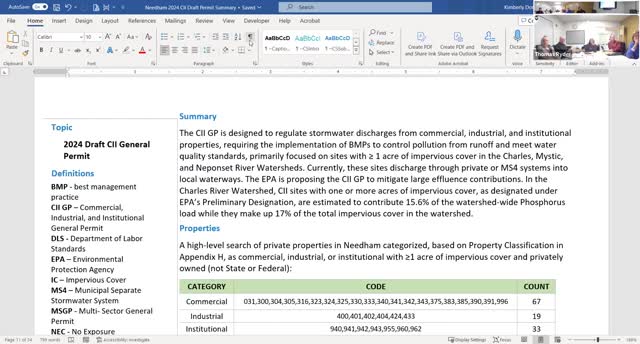
Summary
Town staff told the Needham Stormwater Working Group that a draft EPA "C2" general permit for commercial, industrial and institutional sites could apply to roughly 119 privately owned properties in Needham, and summarized how the permit’s impervious-cover thresholds, reporting requirements and compliance timelines might interact with local rules and a stormwater-fee program.
Town staff briefed the Needham Stormwater Working Group on a draft U.S. Environmental Protection Agency general permit (referred to in the meeting as the "C2" GP) that would require commercial, industrial and institutional properties meeting specified impervious-cover thresholds to implement best management practices aimed at reducing phosphorus and other pollutants.
Staff presented a high-level inventory of privately owned properties in Needham that match EPA’s commercial/industrial/institutional codes and that appear to have at least one acre of impervious cover. Using the town’s property classifications and a rapid report run against the EPA appendices, staff reported the following counts: 67 commercial, 19 industrial and 33 institutional sites — about 119 properties in total — while noting that contiguous-parcel analysis (to confirm whether adjacent parcels owned by the same entity should be combined) remains incomplete.
How the C2 GP would apply: the draft permit is organized around impervious cover (not total land area) and, as discussed at the meeting, applies to privately owned sites in selected watersheds (staff cited the Charles River, Mystic and Neponset watersheds during the briefing). Multifamily housing of eight units or more may be included in the permit in later versions, staff said. The working group noted that publicly owned or state-owned sites are treated differently under federal permitting and generally are not counted in the same way as private sites.
Deadlines and compliance timing described in the briefing: staff summarized EPA timelines mentioned in the draft permit: owners of affected sites would need to file a Notice of Intent (NOI) by deadlines tied to impervious-area bands (the staff summary cited the draft permit’s phased approach) and compliance schedules would require different timelines for achieving pollutant-reduction obligations depending on site size. During the meeting staff reported the compliance windows discussed in the permit: for NOI submission the draft used shorter deadlines for larger sites and the compliance periods ranged from one to three years depending on impervious coverage; staff emphasized these timelines depend on the permit’s final effective date and could change.
Technical requirements and reporting: the draft permit would require each permittee to prepare a site-specific stormwater pollution control plan and to select, design, install and maintain stormwater control measures to meet phosphorus-reduction outcomes. Staff gave an example of the mass-based calculation used in the draft: impervious acres times a site-specific pounds-per-acre factor (the briefing used 1.8 lb/acre as a working figure) multiplied by the watershed’s reduction target to produce a pounds-of-phosphorus reduction responsibility for a site; staff cautioned the group that the formula and factor inputs come from EPA appendices and are subject to change.
Potential local impacts discussed: the group discussed how the federal permit could affect the town’s stormwater utility and crediting program. Staff said properties covered under the C2 permit may be removing phosphorus under their own permit obligations and therefore could be eligible for credits or lower charges under a local stormwater-fee structure; conversely, the town’s own phosphorus-reduction responsibilities could shrink as privately permitted sites reduce loads that otherwise would fall to the municipal system. Staff cautioned the group not to assume immediate effects: whether the town’s fee revenue or obligations change will depend on the final permit text, the implementation schedule and whether site coverage is shown to remove the pollutant loads the EPA requires.
Unknowns and next steps: staff emphasized a number of information gaps: the EPA interactive impervious-cover map is based on 2016 data (so changes since 2016 are not captured), contiguous-parcel ownership needs verification, and it was not clear whether property owners had been directly notified by EPA. Staff suggested the town could notify identified owners that a federal proposal may affect their site, but members cautioned against alarming owners before the permit is final. The working group asked staff to prepare written summaries for outreach, to track EPA public meetings and public-comment deadlines in late January (staff referenced EPA hearings scheduled in late January during the meeting) and to identify which of the roughly 119 properties may be contiguous or otherwise ineligible.
Why it matters: if finalized as proposed, the EPA C2 GP would add a federal layer of permitting for some private sites that could change local responsibilities, create administrative and O&M costs for property owners, and intersect with Needham's planned updates to its own stormwater bylaw and fee/credit program. The working group asked staff to include the C2 permit discussion in public outreach materials and to consider potential credit language for permittees in the town’s stormwater-fee framework.