Get Full Government Meeting Transcripts, Videos, & Alerts Forever!
Get email alerts on the Board Rules topic
No spam. Unsubscribe anytime.
Ottawa County commissioners reopen their rules: chair term, public comment and invocations prompt long debate; final vote delayed
Summary
The board spent more than four hours reviewing proposed board rules — debating chair term limits, who may give invocations, public-comment formats, and corporate-counsel access. Commissioners agreed changes but postponed final adoption for legal review and a rewritten draft.
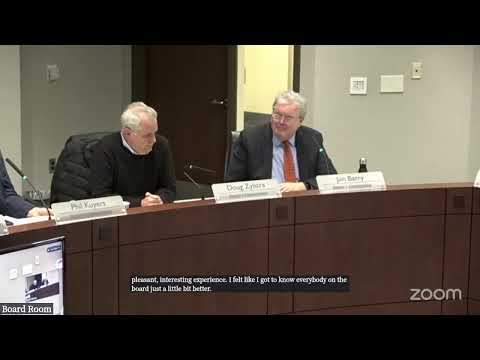
The Ottawa County Board of Commissioners spent much of its Jan. 7 meeting discussing a proposed rewrite of its board rules — an in-depth review that touched on the term of the chair, who may give invocations, limits on public comment, committee structure and who may speak with county legal counsel.
Commissioners did not adopt a final package. After hours of discussion and several procedural votes, the board voted to postpone final approval until its next regular meeting, giving counsel time to review open legal questions raised during debate.
Why it mattered: The rules would govern everything from how commissioners are chosen to chair committees and how the board handles public comment. Several changes drew sustained attention:
- Chair term and limits: Commissioners discussed statutory language (Michigan Compiled Laws) requiring a chair election every odd-numbered year for a two-year term unless the board adopts a resolution for one-year terms. Several commissioners said they favored limiting consecutive service to keep leadership rotating; the board agreed to include statutory text and to clarify a one-year election option in the written rules, with a recommended maximum of two one-year terms within a commissioner’s four-year elected term. Commissioners asked the chair to resign and be re-elected under clarified terms at a future meeting if the board adopts one-year terms.
- Public comment and meeting access: Commissioners debated how many public-comment windows to hold and whether a first comment period should be limited to agenda items. After lengthy public input and internal discussion, the board kept the two public-comment periods but agreed to emphasize to speakers that comments given at the first session be “encouraged” to address agenda items; commissioners stopped short of strictly limiting topic choice.
- Invocations and faith expression: The board debated whether invocations should be limited to commissioners or open to members of the public. Legal counsel flagged past litigation risk; several commissioners argued a commissioners-only approach reduces legal exposure. After discussion the board agreed to a commissioners-first approach for invocations, allowed existing sign-ups to proceed for the current meeting cycle and referred the broader invocation policy to a planning-and-policy review.
- Corporate counsel and legal access: Commissioners questioned whether the county attorney should report to the administrator or directly to the board and how commissioners may access legal advice. The chair said he sought explicit authorization to consult outside litigation counsel in time-sensitive cases. Several commissioners said individual access to legal counsel has been important for oversight; others cautioned uncoordinated outreach can create conflicts. The board asked legal counsel to draft clearer language about who may consult attorneys, what topics should be reserved for closed session, and how the chair and administrator should coordinate legal contact.
- Committee structure and calendar: Commissioners discussed consolidating standing committees into two bodies — Planning & Policy and Finance — meeting on the second Tuesday of each month with the full board meeting on the fourth Tuesday. That schedule (9 a.m. committee start, 6:30 p.m. evening board meeting alternating by month) was adopted for the calendar and will be used while staff and departments adjust. Supporters said consolidation can shorten full-board agendas and allow staff time to prepare; some department heads asked for more lead time for materials and workflows.
Outcome: Commissioners accepted multiple edits and “tentatively adopted” many changes as working language, but they postponed a formal, final vote so corporate counsel and staff can reconcile statutory requirements (for example, on board and commission terms) and confirm term expiration dates across dozens of county-appointed bodies. The board set its next meeting and asked staff to circulate an updated draft before the Jan. 28 session.
What to watch: The board asked legal counsel to clarify (1) statutory limits on chair terms, (2) the process for commissioner vs. public seats on statutory boards, and (3) rules governing commissioners’ independent contact with outside litigation counsel. Staff also will produce a calendar and confirm which boards must keep their existing bylaws and which can be aligned under the new committee structure.
No final rule was adopted; the board will revisit a revised draft at its Jan. 28 meeting.
Context: Commissioners said a main aim is to make meetings shorter and more predictable while preserving residents’ ability to speak and protecting the county from legal risk. Several public speakers urged transparency and requested the board resist excessive centralization of power in the chair’s office.