Lifetime Citizen Portal Access — AI Briefings, Alerts & Unlimited Follows
Public commenters urge full Cleveland rebuild, Native Student Success Center and clearer bond terms ahead of Portland schools vote
Loading...
Summary
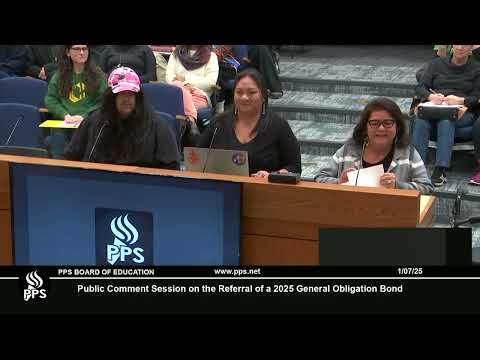
Public comment before the Portland Public Schools (PPS) Board of Education on Jan. 27 focused on restoring full funding for the planned Cleveland High School rebuild, adding a Native Student Success Center to the bond package and clarifying the bond’s size and financing structure ahead of a likely May vote.
Public comment before the Portland Public Schools (PPS) Board of Education on Jan. 27 focused on restoring full funding for the planned Cleveland High School rebuild, adding a Native Student Success Center to the bond package and clarifying the bond’s size and financing structure ahead of a likely May vote.
Speakers said the bond proposal, as drafted, risks losing voter support because it is large and, they said, presented in ways that many community members find confusing. "I would like to see you pass a bond. I don't think you can pass this bond. It's too vague. It's too complicated," said John Charles of Cascade Policy Institute during the public comment period.
Why it matters: The 2025 general obligation bond would fund the last two high‑school modernizations in PPS’ multi‑year capital program and other district capital needs. Community members said the board’s decisions now — about project scopes, costs and whether to include items such as a Native Student Success Center — will affect both voter turnout in a May election and long‑term equity across the district’s high schools.
Several Cleveland students and staff urged the board to keep the district’s previously defined standards and budget for Cleveland’s rebuild. Evan Juneman, a senior at Cleveland High School, said reductions proposed by district leaders would compromise the design work contributed by students and community members and would lead to higher long‑term costs. "From all the work I've seen done on the design for the new building, I can say that there is simply no way for that much money to be saved without sacrificing the basic needs of the students," Juneman said.
An 18‑year Cleveland teacher and parent, Keska Kemper, told the board the current projected cost for Cleveland — which speakers referenced at times as about $450 million to $460 million — reflects local construction realities and the board’s own facility standards. "Building high schools that do not meet this board's own standards would be a regrettable and shortsighted choice," Kemper said.
Students described safety, accessibility and health problems at Cleveland. Calisto Ford, a junior and vice president of his school's disabled and neurodivergent student union, described a frequently failing elevator and other conditions he said deny disabled students regular access to classes. "For 2 weeks during late September early October, our elevator broke... 1 of my friends who used a wheelchair missed 2 weeks of all of his classes on the 3rd floor," Ford said.
Several speakers asked the board to include a Native Student Success Center in the bond package to provide culturally sustaining space and curriculum resources. Noreen Smoky Smith, an elder representative on the Indian Parent Committee (IPC) and a retired PPS educator, said the district "is failing our native students miserably" and described a history of IPC advocacy. She and other speakers outlined potential funding sources they said could pay for a Native center without raising the district’s tax rate, including using interest earnings from the bond and lengthening the bond authorization rather than increasing the levy rate.
Robin Butterfield, who said she serves on the National Advisory Council for Indian Education, urged the board to commit a site for the center and use bond funds for both facilities and culturally specific curriculum. "What's really important to us as native people is a place," Butterfield said, noting that bringing students together in a single site has shown measurable benefits in other districts.
Financial concerns were raised about the bond’s proposed structure. Rob Galanakis, a PPS parent and PTA president, referenced a December bond presentation option he said would require a 32‑year authorization and pay about $1.7 billion in interest over the life of the bond. "Passing a $1,800,000,000 bond without raising the levy rate would involve a 32 year authorization and paying $1,700,000,000 of interest," Galanakis said, urging the board to consider a smaller bond or different levy approach.
Supporters of full funding said cutting the Cleveland budget now would undercut community trust and equity. Several speakers — including students, teachers and alumni from Ida B. Wells‑Barnett and other schools — said delays and reductions would perpetuate a "have/have‑not" situation across neighborhoods and programs, and could harm programs that require specialized space such as athletics, CTE and the arts.
Cleveland students described overcrowded and unsanitary conditions, and warned that perceived downgrade of the new building would depress turnout among Cleveland families in a May vote. "Our cafeteria has a leaking ceiling and fits less than a quarter of our student body... Most of us eat lunch in the hallways," said Sofia Mauro Lavelle, a Cleveland sophomore.
The public comment session closed at the board chair’s direction; the board recessed and reconvened for its regular meeting at 6:05 p.m. No formal board action on the bond occurred during the public comment period.
Votes at a glance: none (public comment only).