Get Full Government Meeting Transcripts, Videos, & Alerts Forever!
Get email alerts on the State Legislation topic
No spam. Unsubscribe anytime.
State legislators outline rural funding, infrastructure and recycling priorities in Templeton
Summary
Sen. Pete Durant and Rep. John Zlotnick visited the Town of Templeton select board to review local priorities including municipal finance, Chapter 90 road funding, school aid formulas and proposed changes to recycling/incineration legislation.
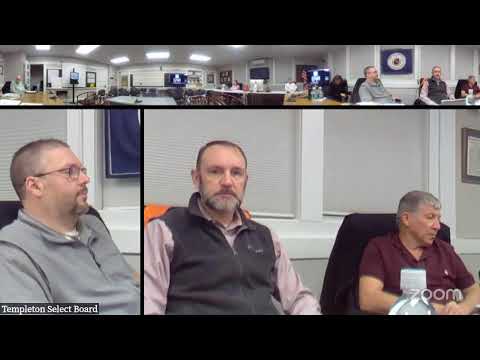
Sen. Pete Durant and Rep. John Zlotnick told the Town of Templeton Select Board on Jan. 8 that rural towns remain a priority but will likely have to keep pressing the Legislature for changes to longstanding state funding formulas.
The lawmakers met with the select board and other local officials in a scheduled delegation visit and spent the bulk of their remarks on municipal finance, the Chapter 90 highway program, and education funding through Chapter 70. Rep. Zlotnick said that, despite repeated efforts to update Chapter 90, the program’s formula and scale have not kept pace with local needs: “The chapter 90 program was never designed to be a way for municipalities to pave roads, but over time, that's what's become of it,” he said.
Why it matters: Templeton leaders stressed that municipalities shoulder most road and bridge maintenance while Chapter 90 funding has been effectively flat for years. Both legislators said they continue to press for formula reforms and supplemental rural programs, and noted the difficulty of winning changes in a 200-member legislative body where regional priorities differ.
Details and debate: Speakers discussed several revenue and policy threads. Zlotnick and Durant pointed to recent, temporary revenue surges around the COVID-era budgets but said year-to-year growth is returning to past norms, which can squeeze local budgets. They suggested multi-year Chapter 90 funding and a rural factor in distribution formulas as possible remedies. Durant added that other programs — small bridge funds and federal infrastructure allocations — can help while broader reforms are pursued.
The delegation also discussed a set of other statewide proposals that affect rural towns. Board members raised concerns about new requirements tied to truck safety equipment, state mandates on electric heavy vehicles, and a recycling bill (filed in a prior session as “3701”) that some locals fear would enable advanced recycling processes akin to incineration. Select Board member Carrie (last name not specified in transcript) asked about how quickly a bill might move: “I don't know if you can push that bill through in 2 years instead of 4,” she said; the legislators replied that major bills commonly require several sessions and that language and interagency coordination often cause delays.
On health care and veterans issues, both legislators noted state efforts to shore up rural healthcare financing and veteran housing projects; Rep. Zlotnick referenced recent legislation amending oversight of hospital closures as relevant to local emergency medical response and transport times.
What’s next: The legislators asked town officials to keep sharing local data to support applications for state programs and earmarks; both offices said they are accessible and available to help shepherd projects through state agencies and the budget process.
Ending: The delegation left the select board with a pledge to continue nudging state agencies on behalf of rural districts and to work with Templeton leaders on specific bridge and road funding requests as the next state budget cycle advances.