Get Full Government Meeting Transcripts, Videos, & Alerts Forever!
Get email alerts on the Infrastructure Transit topic
No spam. Unsubscribe anytime.
River Valley Regional Commission highlights transit expansion, $1.3B TIA investments and aging services in Harris County update
Summary
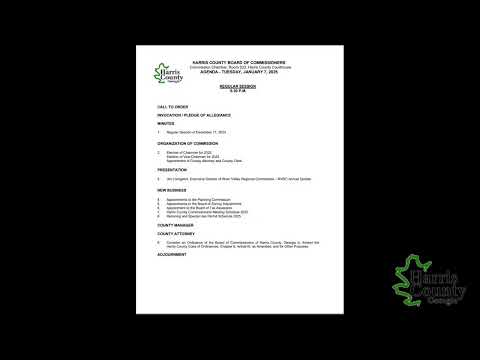
Jim Livingston, executive director of the River Valley Regional Commission, told the Harris County Board of Commissioners on Jan. 7 that regional transit service has returned to more active service in Harris County and outlined large, multi-year transportation investments and social-services programs that touch the county.
Jim Livingston, executive director of the River Valley Regional Commission, told the Harris County Board of Commissioners on Jan. 7 that regional transit service has returned to more active service in Harris County and outlined large, multi-year transportation investments and social-services programs that touch the county.
Livingston said the regional commission uses local dues to leverage federal funds and highlighted three program areas: the area agency on aging, planning and government services, and workforce development. He told commissioners their per-capita dues help unlock federal grants and said, “In this last fiscal year, we turned that $1 from Harris County, per capita investment into $23.52 worth of investment throughout the region.”
On transit, Livingston credited the Lower Chattahoochee Regional Transit Authority for putting buses into Harris County and said the commission is working with the city of Columbus to make transfers at the Linwood Boulevard transfer station more seamless for county riders. He said flyers and outreach materials would be placed at senior centers and Mercer Medical and that, to date, the service has cost Harris County nothing, though he warned county support may be required in future months.
Livingston described infrastructure spending under the Transportation Investment Act (TIA), saying the region expects roughly $1.3 billion of transportation investment over a 20-year period. He identified projects affecting Harris County: the US 27 widening currently under construction on the county’s east side and two State Route 315 projects (Hart Drive to Mulberry Grove, and the 315/219 intersection) that are in preconstruction under TIA 2. He also referenced 219 passing lanes completed in the first round and said the region collected about $120 million through September for TIA 2 to fund named projects and local discretionary shares.
Livingston highlighted the commission’s work on aging programs: 38 senior farmers markets that distributed 3,782 vouchers in the region (including Waverly Hall), 151,000 home-delivered meals and an on-staff dementia care specialist who has worked with more than 500 families to provide training and support. He also noted the commission won a Safe Streets for All grant for intersection and safety improvements.
On county data services, Livingston said the Harris County data hub is live and being fed via a state contract that regional commissions use; he encouraged county staff and residents to review the online hub and the regional commission’s annual report at rivervalleyrc.org.
Why this matters: Transit connections, TIA-funded road projects and aging services shape mobility, safety and the local economy in Harris County. Commissioners and staff were urged to coordinate with the metropolitan planning organization and to use regional grant and planning resources to cover local infrastructure needs.