Get Full Government Meeting Transcripts, Videos, & Alerts Forever!
Get email alerts on the Transportation Safety topic
No spam. Unsubscribe anytime.
Village presents corridor vision; district and village to coordinate on pedestrian safety near schools
Summary
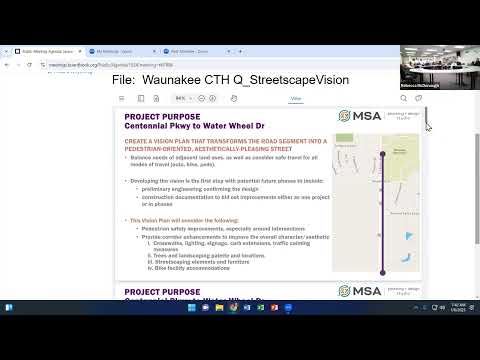
Village staff presented a corridor improvement vision between Centennial Parkway and Waterwheel that emphasizes pedestrian safety, lighting, medians, and potential trail connections. Village staff sought district feedback because parts of the work touch school property and existing crossing-guard locations.
Village of Waunakee community development staff presented a corridor vision to the Waunakee Community School District Facility Committee, asking for feedback on pedestrian safety, crossings, and how the plan would affect school property and students’ walking routes.
Lauren Dietz, the village’s community development director, told the committee the project’s goals are safer intersection crossings, improved pedestrian and bicycle comfort, better pedestrian connectivity and corridor beautification between Centennial Parkway and Waterwheel. Vision elements shown to the committee included redesigned medians and plantings, pedestrian “respite nodes,” tighter turn radii at key intersections to shorten crossing distances, ladder-style crosswalks, multiuse paths along the west side, and downtown-style pedestrian-scale lighting.
Dietz and village staff said a signal-speed study and traffic counts had identified locations where drivers exceed the posted speed and where crossing improvements may be needed. The village suggested moving some crosswalks into medians to create central refuge space for pedestrians and discussed options for removing a southbound bike lane in favor of a widened multiuse path in select sections.
District members and staff raised questions about cost and right-of-way: village staff said the corridor work would be a village-led project, but portions on school property would require district agreement. Village staff said some features beyond the village’s core scope—retaining walls, campus signage, or enhanced parking for athletic events—would likely be district expenses if the district wanted them. The village plans to take the plan to the planning commission and then to the village board; staff invited the school board to offer feedback at those steps.
Village and district staff discussed using crossing-guard counts and time-of-day observations to inform engineering decisions; district staff said the new crossing guard can collect usage data and that existing crossing guards have provided on-the-ground feedback already. No formal district action was required; staff asked the committee for feedback and to consider how corridor options might fit district campus and long-range facility planning.