Get Full Government Meeting Transcripts, Videos, & Alerts Forever!
Get email alerts on the Coastal Restoration topic
No spam. Unsubscribe anytime.
Atchafalaya Basin advocate proposes slurry pipeline to move Mississippi sediment into Terrebonne Parish
Summary
Dean Wilson of Atchafalaya Basin Keeper presented to the Terrebonne Parish Council a multi-part plan to capture sediment from the Atchafalaya/ Mississippi system and transport it via slurry pipeline to rebuild land and restore basin capacity; councilmembers asked about cost, timing and funding sources.
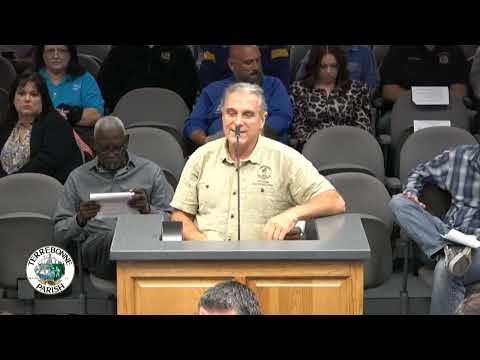
Dean Wilson, representing Atchafalaya Basin Keeper, presented a plan to the Terrebonne Parish Council on Nov. 20, 2024 to capture sediment in the Atchafalaya Basin and move it by slurry dredge and pipeline to rebuild land in Terrebonne Parish and restore the basin's flood capacity.
Wilson told the council the basin’s sedimentation is reducing spillway capacity and increasing flood risk for large parts of south-central Louisiana, and said his group’s plan would realign distributaries, place sediment traps, and use a fixed slurry pipeline and lateral connections to move material to targeted locations in the parish. “I just want everybody to realize this is not a diversion. This is a pipeline,” Wilson said during his presentation.
The plan Wilson described has three main components: keep sediment in the main river by realigning channels and installing weirs and traps; mine accumulated sediment in locations such as former lakes and transport it by pipeline to build land and reduce the need for repeated navigation dredging; and restore some hydrologic connectivity by installing controlled “leaky” levees, siphons and gates to improve floodplain drainage and ecological exchange. Wilson said work on a draft master plan is underway and that he is working with a scientist identified in the presentation as Dr. Auerban Herdan.
Council members asked several practical questions. Councilman Babin praised the concept but cautioned about cost and right-of-way issues, noting past proposals and that pipeline rights-of-way are a major constraint. Parish officials and council members asked whether the Coastal Protection and Restoration Authority (CPRA) had reviewed the plan; Wilson said CPRA was preparing a coastal master plan that could include the idea and that his group intends to submit the proposal to CPRA for consideration. Wilson cited a state figure of about 2,500,000,000 cubic meters of sediment accretion between 1932 and 2000 as part of his explanation of scale.
Council members and the parish president pressed for cost estimates and funding sources; Wilson did not provide a project cost but said he expects the plan to be funded primarily with state and federal dollars rather than local funds and described the work as a long-term, large-scale restoration investment. The parish president said he had spoken informally with CPRA staff and asked Wilson whether he planned to formally present the plan to CPRA; Wilson said that was his intent and asked for the parish’s support in a joint proposal.
Wilson and councilmen discussed navigation and dredging impacts near Morgan City; Wilson noted dredging costs observed locally and argued that a pipeline and management strategy could reduce recurring navigation dredging needs by capturing sediment before it accumulates in navigation channels. He also described expected ecological benefits — restoring fisheries and flood-plain productivity — but did not supply a timeline or firm cost estimate.
The council did not take any formal action on the presentation; Wilson was given time for questions and told council members he would provide contact information for follow-up and would seek parish endorsement if the council wished to support a CPRA submission.
The presentation and follow-up Q&A highlighted technical, funding and rights-of-way questions that would need to be resolved before any formal parish involvement or funding commitment.