Get Full Government Meeting Transcripts, Videos, & Alerts Forever!
Get email alerts on the Tax Reform topic
No spam. Unsubscribe anytime.
State representative summarizes tax reform, warns parish leaders of inventory tax deadline
Summary
State Rep. Jessica Domingue told the Terrebonne Parish Council that the legislature’s recent tax package cuts personal and corporate taxes while temporarily raising sales tax, and said parishes must decide by July 1, 2026 whether to eliminate local inventory (ad valorem) taxes to qualify for incentives.
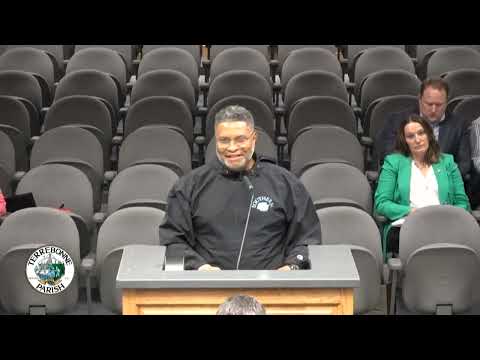
State Representative Jessica Domingue outlined the main elements of the legislature’s recently passed tax package and told the Terrebonne Parish Council on Dec. 8 that local officials must begin planning now for an inventory-tax decision that could affect local budgets.
Domingue (State Representative) told the council that HB 10 sets a flat 3% individual income-tax rate with increased standard deductions and folds several sales-tax changes into the same bill. The package also repeals the corporate franchise tax, moves many constitutional tax incentives into statute, and keeps some credits — notably the motion-picture and historic tax credits — in place, she said.
The measure also makes temporary changes to the state sales tax: Domingue said lawmakers made a 4.45% levy permanent and raised the total state sales rate to a flat 5% for five years, with the increase set to sunset in 2030. She said HB 8 establishes a sales tax on digital goods and services (streaming, digital books, apps and similar products) and estimated revenue from that source at roughly $500 million to $1 billion.
Domingue said HB 11 and related provisions address ad valorem (inventory) taxes. She said the legislature provided incentives for parishes that choose to stop collecting inventory taxes: the state will offer a one-time $15 million incentive if a parish acts early, with the amount reduced if the parish delays. Parishes that stop collecting inventory tax will have until July 1, 2026, to act and will need to coordinate decisions with local entities that receive ad valorem revenue — for example, recreation and fire districts, school boards and veterans boards.
Domingue stressed the decision is a local one. “You guys have buy-in on that,” she said, and added the state will offer technical help. Council members asked how lost ad valorem revenue would be replaced; Domingue said severance-tax changes and the new sales-tax structure are intended to help backfill local shortfalls and that the governor’s office and delegation are available to assist.
Domingue also described a constitutional amendment package connected to the tax plan: it would preserve the homestead exemption in the constitution, modify the Budget Stabilization Fund rules, and include a teacher pay component tied to paying down retirement debt. She said the plan would allow school boards to give teachers a $2,000 raise and ancillary staff $1,000 once the retirement debt is addressed.
Council members raised local concerns repeatedly: several said small recreation districts and fire districts rely on inventory tax receipts and would face substantial shortfalls without a transition plan. Councilmember Jeff Babin said one recreation district he represents could lose as much as $300,000. Councilmember Robert Bejron (Parish President) and others called for a task force of council and administration representatives to model the local fiscal impacts before a final decision.
Domingue said the package was the result of intensive negotiations in Baton Rouge and that the legislature intentionally preserved certain tax credits and protections. “We’re not eating the elephant in one bite,” she said, describing the legislative plan as the first step and noting further adjustments could come in the spring fiscal session.
Domingue repeatedly offered to meet with parish leaders and said state staff would help local officials prepare options for their review. She identified the governor’s office and the parish’s state delegation as partners available to assist with modeling and transition planning.
Why this matters: The package changes state tax policy and shifts a complex fiscal decision to parish governments. If the council and administration choose to stop collecting inventory tax, local districts that currently receive ad valorem revenue will need replacement funding or local restructuring. The council faces an explicit July 1, 2026, deadline to act in order to access the largest state incentive Domingue described.
Domingue’s presentation and subsequent council questions focused on (1) the scale and timing of local revenue changes, (2) the $15 million early-incentive offer, (3) the five-year sales-tax increase that sunsets in 2030, and (4) the state’s offer of technical assistance to parishes and their local service districts.
Ending note: Domingue encouraged local leaders to form working groups with the administration and the parish’s state delegation to model options, and said the governor’s office would provide assistance if requested.