Get Full Government Meeting Transcripts, Videos, & Alerts Forever!
Get email alerts on the Council Goals And Budget topic
No spam. Unsubscribe anytime.
Milwaukie holds goal-setting town hall; City Manager previews 10 goal ideas and asks public to pick up to three
Summary
City Manager Emma Sagor opened an interactive town-hall/open-house Jan. 7 asking Milwaukie residents to weigh in on 10 proposed council goals that would guide budget and staff priorities for 2025–27. The council plans a retreat Jan. 31–Feb. 1 and expects to adopt up to three goals by resolution in February.
Milwaukie City Manager Emma Sagor told a small, in-person audience on Jan. 7 that the city is gathering public input on 10 candidate goals that the City Council may adopt to guide work and budgeting for 2025–27. The event was run as a town-hall/open-house at Milwaukie City Hall; the interactive portion was not broadcast or recorded.
Sagor said the council intends to adopt up to three goals with implementation time frames of one to three years and to align any adopted goals with the city’s biennial budget process. "I'm going to be helping them select those up to 3 goals. I'm not letting them out of that room until they've picked those goals," Sagor said during opening remarks.
The city manager outlined 10 topic areas the council has drafted so far: promoting economic development across the city; achieving governmental financial stability; improving transportation safety on city streets; developing proactive land annexation strategies; enhancing housing affordability; collaborating with regional partners to assist residents most in need; creating a robust park system; securing funding for removal of Kellogg Dam and restoration of the Kellogg Creek floodplain; improving community preparedness for emergencies; and making the city’s water infrastructure more resilient.
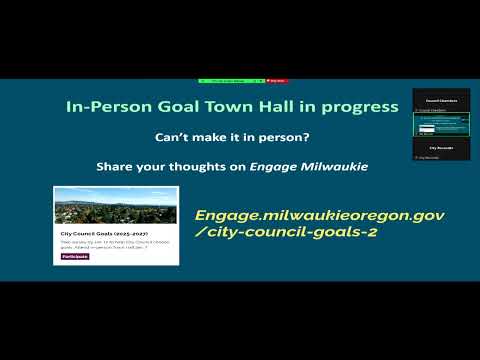
Sagor described the public-input process: stations around City Hall and in the lobby staffed by council members and directors, physical sticky-note feedback, and an online survey on the Engage Milwaukie site. She encouraged broad participation and noted the online survey was open through Jan. 12; "We've got, I think, about a 150 folks who have taken that so far," she said, asking attendees to spread the word.
After the engagement period the council will meet at a retreat Jan. 31–Feb. 1 to review public input and supporting data, set measurable actions and performance measures, and select up to three goals. Sagor said council would adopt the goals by resolution in February; the city will then use the goals to inform the mid-2026 biennial budget cycle.
Sagor also reviewed how prior council goals — equity, justice and inclusion; climate mitigation and resilience; and park improvement — have been embedded into city work, citing the creation of an equity and inclusion coordinator, an equity steering committee, a climate action plan and recent park upgrades such as Scott Park and near-complete projects at Bowman Bray and Balfour.
The meeting format emphasized short-term, actionable outcomes: staff and council requested that proposed goals be specific, measurable and able to be resourced or prioritized within the city budget. Attendees were asked to visit stations, leave written ideas, and use three sticky dots at the end of the event to indicate which three goals they would prioritize if they could choose only three.
A resident, Rod Smith, asked whether an eleventh idea could be added; Sagor said the lobby station includes a board where participants can write ideas "we missed" and that the online survey includes the same prompt.
City leaders said quarterly updates and public reporting would follow adoption so the council and public can track progress on any selected goals.