
Board hears review of school food‑service models; officials weigh contractor vs. self‑operated options
Get AI-powered insights, summaries, and transcripts
Sign Up Free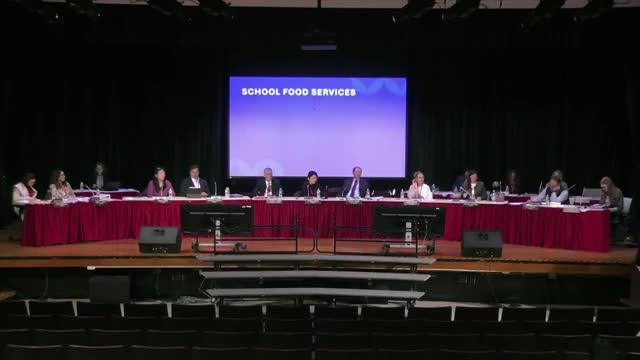
Summary
The Board of Education heard a detailed review of school food services, including federal and state oversight, procurement rules and the tradeoffs between contracting with a food‑service management company and operating the program in‑house.
The Board of Education heard a detailed review of school food services, including federal and state oversight, procurement rules and the tradeoffs between contracting with a food‑service management company (FSMC) and operating the program in‑house.
Doctor (Dr.) Ruffo, presenting the district’s analysis, told the board the National School Lunch Program (federally administered) and the New York State Education Department Child Nutrition Unit set the rules for school meal programs in New York, and those rules shape procurement, menu requirements and reporting.
Why it matters: The choice between an FSMC and self‑operation affects menu variety, responsiveness to student preferences, labor and benefit costs, compliance burdens, and the district’s long‑term capital needs for elementary kitchens. It can also influence meal prices, program subsidies and whether the district must subsidize a school lunch fund from general‑fund money.
What presenters told the board
- Two models: Dr. Ruffo summarized the FSMC model — present in many Nassau County districts and used previously in Syosset (Aramark, Whitsons) — versus self‑operation, in which the district hires staff, runs procurement (often via cooperative bids) and assumes all program management.
- Procurement and flexibility: The FSMC model uses larger purchasing networks and experiences economies of scale; districts can specify quality in the bid but modifications to the state prototype bid require state approval. Dr. Ruffo said some menu or sourcing changes (for example a new item) could be introduced faster under a self‑op model but noted both models must comply with federal and state nutrition and food‑safety requirements.
- Menu variety and special diets: In a review of local menus, FSMC providers tended to offer more options on a given day; Syosset was noted as one of the few districts offering both halal and kosher options. The district installed countertop pizza ovens in elementary schools to improve quality for transported meals.
- Labor and costs: Food service labor shortages affect both models. Dr. Ruffo reported that self‑operated programs in the counties reviewed typically showed higher meal prices (lunch roughly 3–4% higher, breakfast 11–23% higher in the sample) and that self‑op districts sometimes require transfers from the general fund to cover program shortfalls (examples ranged from about $24,000 to $457,000 in other districts). He cautioned that civil‑service hiring rules and benefits costs can increase self‑op program costs.
- Financial and operational tradeoffs: FSMC contracts include guaranteed returns and predictable meal pricing linked to CPI; self‑op programs can be more responsive and offer greater local control but usually face greater financial volatility and personnel management responsibilities.
Board questions and follow‑up requests
Board members asked whether large districts similar to Syosset operate self‑op programs and whether hybrid approaches (e.g., self‑operation at elementary schools with a contractor for secondary) are permissible under New York State prototype contract language. Dr. Ruffo said he was not aware of hybrid arrangements in Nassau County and noted prototype contract language and state rules could limit some hybrid approaches. He also said waivers or pilot approvals might be possible but would require discussion with the State Education Department.
Members requested additional district‑specific analysis: estimated total cost to move to self‑operation for a district Syosset’s size (including salaries, benefits and pension), projected impact on meal prices and participation rates, and comparisons of student meal participation in similarly sized districts under each model. Board members also asked for data on student satisfaction and program compliance risk.
Quote: Dr. Ruffo noted the district’s current menu offerings and said, “Syosset seems to be the only 1 that offered both halal and kosher,” highlighting the district’s existing accommodation of culturally specific meals.
Ending: Trustees did not make an immediate decision. Officials said they will compile additional cost and participation data, consult with the Child Nutrition Unit about possible pilot or waiver options, and return with a sharper, district‑specific financial comparison and risk analysis.