Get Full Government Meeting Transcripts, Videos, & Alerts Forever!
Get email alerts on the Education K 12 topic
No spam. Unsubscribe anytime.
Racine Unified officials cite gains on state report card, credit early‑literacy work and attendance; warn of budget gap
Summary
Racine Unified School District officials on a district podcast said the district’s latest state report card shows measurable gains driven by early‑grade reading instruction, improved attendance and growing graduation rates, while warning that statewide funding that has failed to keep pace with inflation threatens that momentum.
Racine Unified School District officials on a district podcast said the district’s latest state report card shows measurable gains driven by early‑grade reading instruction, improved attendance and growing graduation rates, while also warning that statewide funding that has failed to keep pace with inflation threatens that momentum.
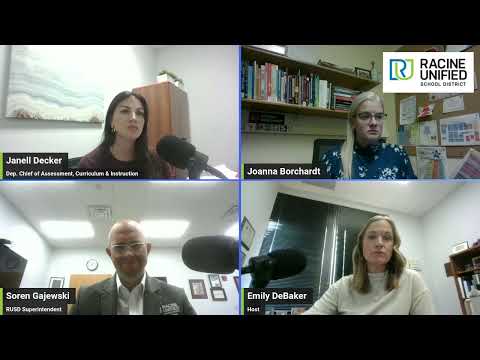
District leaders described the report card as a summative, federally required accountability tool that factors achievement, growth, subgroup performance and on‑track progress toward graduation. “When students can read, they then can access the curricular materials and experiences in the rest of their programming,” said Soren Gajewski, Racine Unified superintendent.
District officials said the most at‑risk students and third graders posted notable growth on state assessments this year, and staff credited several district actions for the gains: adopting practices from the science of reading over the past several years, more frequent in‑year diagnostic assessments and progress monitoring, targeted coaching and stronger instructional leadership in school buildings. Janelle Decker, deputy chief of assessment, curriculum and instruction, said the district created an internal data system for short, frequent checks of foundational skills that teachers enter monthly to guide classroom instruction.
Administrators also pointed to attendance as a key driver. “When students are coming to school and they’re engaging in their coursework … we’re making gains,” Decker said, noting the district tracks attendance closely because absences affect the state report card.
Officials framed high‑school programming changes as complementary to literacy work: academies, college‑credit courses and apprenticeships with local employers give students pathways into college and careers. Superintendent Gajewski said those opportunities—ranging from technical college options at Gateway to apprenticeships with local firms such as SC Johnson—are not fully captured by the state report card but reflect improvements in post‑graduation readiness.
Despite the gains, district leaders emphasized a persistent funding shortfall. Gajewski said state funding has been “decoupled from inflation” since about 2010 and that the district has made significant cuts in recent years; he warned that without new revenue the district may be unable to sustain current supports. Officials said they plan to ask the community to contact state lawmakers about school funding and are “looking at consideration for a referendum” to fill a projected gap over the next five years.
District staff encouraged families to support student success through regular attendance, use of communication tools such as ClassDojo and Infinite Campus, and engagement with classroom teachers. Administrative leaders also highlighted ongoing facility upgrades and new buildings opening next school year as part of long‑term improvement efforts.
No formal board action or vote occurred during the podcast; leaders described plans and priorities and pointed to possible future fiscal measures that would require public processes.
Officials closed the episode by reminding families that the district’s school‑choice window for the 2025‑26 school year is open through Jan. 15, 2025, and invited listeners to explore program options at rusd.org/schoolchoice.