Get Full Government Meeting Transcripts, Videos, & Alerts Forever!
Get email alerts on the Short Term Rentals topic
No spam. Unsubscribe anytime.
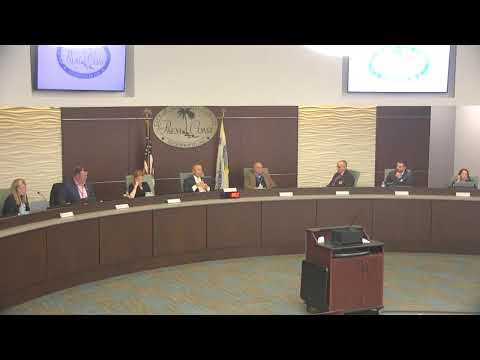
Palm Coast council adopts short‑term rental rules, adds child-age exemption and fee schedule
Summary
After hours of public comment, the Palm Coast City Council on Jan. 7 adopted an updated short‑term rental ordinance, approved an amendment exempting children ages 0–3 from transient-capacity counts and passed a fee structure to fund enforcement and inspections.
Palm Coast City Council on Tuesday approved an amended ordinance regulating short‑term rentals and passed a companion fee resolution to fund enforcement and inspections.
The ordinance (Ordinance 2025xx) amends Chapter 17, Article 5, of the Palm Coast Code to set maximum occupancy and operational rules for short‑term vacation rentals. In the same meeting the council approved a fee structure (Resolution 2025‑xx) establishing an annual registration fee of $375 plus a $75 annual inspection fee, a $375 fee for change of ownership plus a $75 inspection, and a $35 fee to process a change of the responsible party. Staff estimated the fee structure would generate about $123,000 in the first year and said the fee will be evaluated after year one.
The ordinance drew extensive public comment from residents in Palm Coast’s established neighborhoods, who described repeated nuisance problems at neighboring rental houses and urged strict limits. “That limit of 10 is sacrosanct,” said Roger Cressy of the Canal Community Coalition, citing neighborhood complaints. Other speakers said owner‑operators who live at a property tended to keep order; owners operating remotely were described as more likely to generate problems.
Councilman John Gambaro proposed an amendment to exempt owner‑operators who live full‑time in a homestead property from the ordinance’s overall transient occupancy limit (the measure would remove the guest-count cap for in‑home operators). Gambaro said an owner present “9 times out of 10 . . . is going to keep things in order.” Councilman Steven Stevens seconded that motion. The council voted 2–3 against that amendment (Vice Mayor Pontieri and Mayor Norris voted No; Gambaro and Stevens voted Yes; Council Member Miller voted No), and the amendment failed.
Separately, the council considered the ordinance’s treatment of children in the occupancy count. The council approved an amendment changing the exemption for infants from ages 0–1 to ages 0–3 (so children up to 3 years old would not be counted in the occupancy cap). That amendment passed unanimously, and the full ordinance as amended passed unanimously later in the meeting.
During the public comment period dozens of residents described recurring noise, parking congestion and privacy concerns tied to whole‑house short‑term rentals. Several residents said they had stopped using their homes for certain evenings or placed houses on the market because of repeated rental disturbances. Joel Davis, who operates a home with multiple bedrooms and said he lives on the property while renting rooms, described his experience with long‑term compliance and asked for an owner‑occupied exemption for hosts who live at the property.
Council staff said enforcement provisions — including limits on trailers and RVs, parking requirements, and defined maximums per sleeping room — remain in the ordinance, and noted the city had added a code enforcement officer to help address compliance. Lisonbee DiLorenzo, chief of staff, told the council the city would maintain a master record of registered short‑term rentals and would evaluate technology options, including third‑party services that scan listing platforms, though staff said current market tools cannot always split short‑term listings by ZIP code where ZIPs extend beyond city limits.
Council members discussed potential risks of allowing a homestead‑based exemption, saying some residents could falsely claim homestead status to evade rules. The city attorney reminded council members that Florida law preempts local governments from imposing quantity caps on short‑term rentals; that limitation means the city could not place an absolute cap on the number of rentals in the municipality.
On the fee resolution, staff explained the $375 registration plus $75 inspection model was intended to recover the city’s first‑year cost of inspection and administration; staff said the registration will be annual and will include a CPI adjustment. Council approved the fee resolution unanimously.
What happens next: The city will implement the new registration and inspection program, begin maintaining the master record of STRs, and evaluate enforcement staffing and technology after the first year. The ordinance and fee schedule will be enforced by code officers; the council asked staff to report back on technology options and enforcement workload.
Votes at a glance: Gambaro amendment (in‑home operator exemption from max capacity): motion to amend failed (Yes: Gambaro, Stevens; No: Pontieri, Miller, Mayor Norris) — outcome: failed. Child‑age exemption amendment (change exemption to ages 0–3): passed unanimously. Final ordinance (Ordinance 2025xx amending Chapter 17 on short‑term vacation rentals) as amended: passed unanimously. Short‑term rental fee resolution (Resolution 2025‑xx establishing $375 registration/$75 inspection and related fees): passed unanimously.
Sources: Meeting transcript of the Palm Coast City Council business meeting, Jan. 7, 2025; staff presentation materials and council packet (fee schedule).