Get Full Government Meeting Transcripts, Videos, & Alerts Forever!
Get email alerts on the Environmental Stewardship topic
No spam. Unsubscribe anytime.
Winter Haven officials report progress on shoreline, wetlands, tree canopy and storm debris recovery
Summary
City staff presented updates on the Lake Silver revetment, Lake Conine Nature Park, a household hazardous waste collection, urban-forestry work and completion of Hurricane Milton debris collection, and outlined planting and outreach plans for upcoming tree giveaways.
City of Winter Haven staff on Monday briefed commissioners on a series of environmental-stewardship projects that city leaders say are improving shoreline stability, wetland water quality, urban tree cover and post-hurricane cleanup.
Tanya Ayers, director of Safe Neighborhoods, and Brittany Hart, director of Public Works, led a roughly 15-minute presentation summarizing work on Lake Silver, Lake Conine Nature Park, household hazardous-waste collection, urban forestry and debris removal from Hurricane Milton.
The Lake Silver revetment project is intended to reduce shoreline erosion along the lake’s western shore, where a historical railroad embankment and recent recreational use have accelerated bank loss. The chosen approach re-slopes the shoreline and installs a 460-foot rock revetment designed to absorb wave energy rather than reflecting it to adjacent shorelines. The contract was awarded to Shore Builders for just under $330,000; about $250,000 of that amount was provided with assistance from Representative Killebrew through the Florida Fish and Wildlife Commission. The contractor was described as completing work quickly, and staff said the project is expected to finish in January.
Brittany Hart described the Lake Conine Nature Park as a wetland-treatment system that routes stormwater from a roughly 400-acre watershed through a chain of constructed cells. The project’s vegetation and sediment-settling processes were credited with removing what staff characterized as about 30,000 pounds of nutrients per year before water reaches Lake Conine and downstream waters. The park also includes about a mile of trails (a mix of paved and natural surface), a fishing pier, a kayak launch and a connection to the Chain of Lakes Trail. Hart listed Polk County, the Florida Department of Environmental Protection, the Southwest Florida Water Management District and legislative appropriations among the funding partners.
On solid-waste and hazardous-materials collection, staff reported that a December household hazardous-waste event at the Advent Field House served 225 residents and collected a range of materials: 20 fire extinguishers, 47 propane tanks, 51 gallons of paint, 53 large batteries, 172 fluorescent bulbs, 178 tires (the presentation noted that equates roughly to tires from 44 cars and a motorcycle) and about 150 gallons of motor oil/antifreeze/gasoline. Staff emphasized the environmental risk of improper disposal, citing EPA guidance that one quart of motor oil can contaminate 1 million gallons of water.
Urban-forestry work is continuing under a master plan adopted in late 2023. Staff said they completed priority-1 work — 43 tree removals and 31 prunings identified as high risk — and had contracted Summerall Environmental for priority-2 removals and Evolve Professional Landscape for planting and early maintenance. A city map shown to commissioners identified roughly 42,100 available planting spaces on city-owned property and rights-of-way; staff said the plan requires about 150 new plantings to achieve a no-net-loss target and that the city’s annual planting goal is 300–350 trees. Staff also said the city applied to remain a Tree City USA; if approved, Winter Haven would mark its 32nd year as a Tree City and its 17th year to receive the growth award.
Hart said the city has completed three passes of debris collection following Hurricane Milton and has resumed normal bulk-collection schedules. She credited a private contractor, Tucker Paving, with helping haul 85 loads (reported at about 120 tons) early in the response and said the city itself recorded roughly 1,100 loads totaling about 21,000 cubic yards. Countywide hauling totaled about 20,000 loads and approximately 730,000 cubic yards, staff said.
Commissioners asked about additional household collection events, right-tree/right-place planting near utilities, the species used in new plantings and the health of cypress trees planted downtown; presenters said logistics and partnerships determine the number and timing of additional collection events, that code and utility coordination affect planting locations, and that recent cypress plantings in the downtown project are doing well.
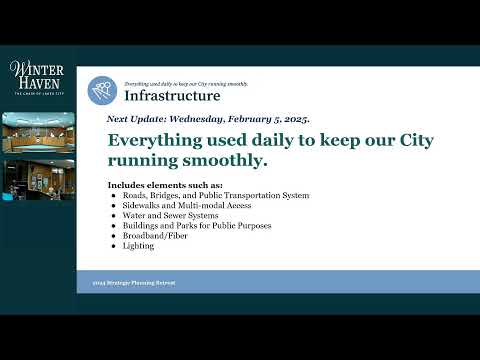
At the close of the update, staff said the next strategic-pillar presentation in February will cover infrastructure topics including roads, sidewalks, utilities and fiber.