Get Full Government Meeting Transcripts, Videos, & Alerts Forever!
Get email alerts on the Affordable Housing Incentives topic
No spam. Unsubscribe anytime.
Milwaukie staff outline proposed zoning incentives to spur affordable housing; council raises concerns on duration and design trade-offs
Summary
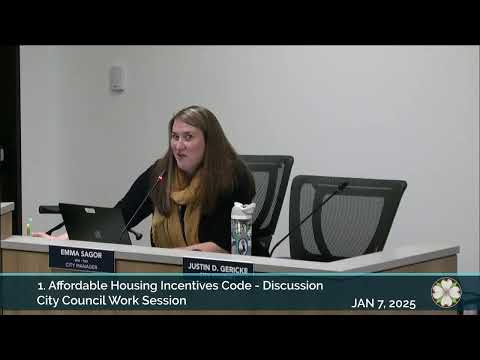
City planning staff on Tuesday presented a proposed Milwaukie zoning amendment that would consolidate affordable-housing incentives into a single code section intended to speed construction and increase the number of income-restricted units.
City planning staff on Tuesday presented a proposed Milwaukie zoning amendment that would consolidate affordable-housing incentives into a single code section intended to speed construction and increase the number of income-restricted units.
The proposal packages multiple land-use variances—such as reduced setbacks, increased lot coverage and an increased maximum density—into an expedited “type 2” review with a 100-day timeline, and ties eligibility to minimum unit counts and income-targeting rules. Staff said qualifying developments must include at least three dwelling units and meet one of several affordability tests; the draft ties continued affordability to deed restrictions for 99 years. City leaders and staff debated whether those thresholds and requirements would be usable for small builders and whether some incentives would undercut design standards or green-space goals.
Why it matters: The change is part of Milwaukie’s housing production strategy, adopted in 2023, and is intended to make it easier for developers to build more affordable units without going through multiple individual variance processes. Councilors said the draft raises trade-offs—less green space and altered downtown design rules for affordable projects—while also asking how the city would ensure long-term affordability and whether the rules would be practical for small-scale or middle-housing projects.
“What we have before us is a code-based approach to addressing affordable housing supply and affordability,” Michael, the city’s planning manager, told councilors. He said the draft pulls elements from Senate Bill 1537 and would let a qualifying applicant package multiple variances into a single application subject to public notice and a planning-manager decision under a compressed 100-day review.
Under the draft, qualifying developments must include at least three dwelling units. Staff described several alternative affordability tests that a development could meet to qualify for the incentives: for example, a share of units restricted at 50 percent of area median income (AMI), a larger share at 80 percent AMI, or a mixed scheme with units at or below 120 percent AMI. Staff also said a development where 100 percent of units are affordable would receive an additional 10 percent boost to incentive amounts, but would not receive an extra height bonus on top of that increase as currently written.
Councilors repeatedly pressed staff to clarify specific numbers and trade-offs. Councilor Anderson asked whether the 120 percent AMI threshold would yield rents too high to be considered affordable for many residents; staff replied that the 120 percent figure is commonly used for “workforce housing” but is open to council direction. The mayor and other councilors said the proposed 99-year affordability term—which the staff report had earlier listed in one place as 30 years—warrants more discussion and might deter smaller developers from using the incentives.
On enforcement, Assistant City Manager Joseph Brighley said the city does not have capacity to monitor long-term affordability for 99 years. He said many developers who use federal HUD funds already have long-term monitoring requirements and that smaller developers seeking the incentives would need to demonstrate an enforcement plan—such as an easement or a contractual monitoring agent—before incentives are granted. “One is certainly not to say the city will be doing the monitoring and enforcement over 99 years,” Brighley said.
Councilors also questioned design consequences. Staff proposed allowing multiunit residential buildings in the downtown mixed-use zone to be reviewed under the city’s multiunit design standards rather than the more exacting downtown design standards if the project is delivering affordable units. The proposal would also permit developers to request variances on design items such as facade articulation, maximum glazing, and limits on ground-floor residential in commercial corridors; staff said the intent is to reduce construction costs that can come from strict design rules.
Several councilors worried that reducing required common area, vegetation or tree canopy could leave projects with minimal green space. Staff noted that the tree code is a separate regulation and that the city does not use the same variance process for tree-code requirements; staff suggested the council could consider alternative “functional equivalent” approaches (for example, green roofs or facades) but said that ecological benefits may differ and that additional work would be required to amend the tree code.
Councilors also asked whether incentives are susceptible to “gaming.” Several said a developer could build a mostly market-rate project with a single income-restricted unit to qualify for broad incentives; staff acknowledged the risk and said council direction on whether incentives should target larger multifamily developments or measure affordability by square footage rather than unit count would help refine the draft.
Council discussion produced several clear lines of feedback for staff: clarify how the minimum-unit and AMI thresholds apply in small or middle-housing projects; consider staggered affordability-term lengths (for example, shorter terms when the city is not providing public funds); decide whether some discretionary approval criteria in the draft should be removed to avoid added procedural burdens; and provide concrete examples showing how the incentives would change lot layouts (for example, what a 5,000- and an 8,000-square-foot lot would look like if a developer used the maximum variances).
Staff said they will revise the draft and return for further discussion and suggested bringing the draft to developers for feedback on whether the incentives would make projects financially feasible. The council paused the work session after roughly an hour and directed staff to return with changes and additional analysis.
Ending: Staff said they will prepare a revised code proposal that addresses the council’s requests—clarifying AMI targets, enforcement expectations, design trade-offs and how incentives would apply to different project sizes—and will return to a future work session before any formal land-use hearings.