Get Full Government Meeting Transcripts, Videos, & Alerts Forever!
Get email alerts on the Port Agreements And Payments topic
No spam. Unsubscribe anytime.
Council hears synopsis of decades-long agreements with Oxnard Harbor District; convoy definitions and payments flagged for follow-up
Summary
City staff summarized multiple legacy agreements with the Oxnard Harbor District dated from 1983, 1987 and 1995 and a 2015 settlement. Council members and residents pressed for clarifications on how the Port reports revenues, how vehicle "convoy" fees are counted and whether some promised actions were completed; staff agreed to follow up.
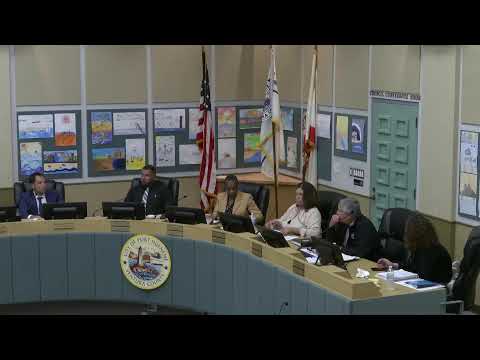
City staff presented a detailed, item-by-item synopsis Jan. 6 of the agreements that have governed financial and land-use relationships between Port Hueneme and the Oxnard Harbor District (the Port) for more than four decades.
The presentation identified four principal vintages of written agreements and subsequent amendments or settlement documents: a 1983 revenue-sharing agreement; a 1987 agreement tied to port expansion and vehicle convoy charges; a 1995 memorandum of understanding (NCELL MOU) governing newly transferred Navy property and associated payments; and a 2015 settlement agreement that clarified revenue-sharing and created a community benefit fund.
City Attorney staff summarized the contracts’ primary features and limitations, including the termination dates for the bundle of agreements (all set to conclude around March 2036). The staff overview emphasized that the older contracts contain many undefined terms, created layered payment obligations and in some places were not fully implemented or tracked in city records. The staff brief noted the agreements allocate port payments for capital improvements, road maintenance, traffic mitigation and other identified infrastructure needs.
Council members and members of the public asked a series of technical and historical questions. Among the most prominent were questions about the calculation and documentation of port payments and the meaning of the term convoy in the agreements. City staff said invoices received from the Port show monthly amounts and that the Port provides annual audited financial statements, but staff could not identify a historical staff report explaining how the original 1983 percentage (0.2778% per month) was derived. Staff noted city records from the 1980s and 1990s are incomplete in the current financial system and that some administrative practices in prior decades were inconsistent with written contract terms.
Port officials attended the meeting and answered several questions. Port Chief Financial Officer Austin Yang said the 0.2778% monthly figure annualizes to roughly 3.33% and said it traces to earlier internal calculations; he told the council he had reverse-engineered the math so staff would better understand the annualized percentage. Yang also summarized the various payment streams the port currently provides to the city as described in the agreements: the percentage-based shares (historically 0.2778% under the 1983 agreement, 1.6% under the 1987 agreement and 3% tied to the 1995 NCELL MoU for certain revenue thresholds), and a vehicle-convoy charge.
On the convoy fee, city staff said the contracts include a per-vehicle charge that was designed to apply to vehicles convoyed over city streets; the agreement limits the countable vehicles in a year to 50,000 and prescribes a base per-vehicle amount (with scheduled increases). Council members and staff highlighted that the term convoy is not defined in the agreements, and they requested documentation of how the Port has interpreted and counted vehicles historically. Port CFO Yang said the Port’s monthly invoices include convoy counts and that a sizeable portion of annual convoy revenue goes to the city, but he offered to work with city staff to provide more detail and historic supporting documentation.
The 2015 settlement agreement also created a City-Administered Community Benefit Fund with procedures for selecting projects; the Port and city staff said the fund has supported shoreline protection, community development and other projects, and the Port said roughly $40 million has been contributed to the City’s general fund over the life of the agreements with about $2.9 million in the most recent fiscal year.
Public comment at the item reflected neighborhood concern about the Port’s 10-year strategic plan, traffic and emissions. Residents and a local homeowners association representative urged clearer communication from the Port about planned increases in cargo or rail activity and requested joint meetings between the council and port commissioners. Jan Burke of the Hueneme HOA Coalition told the council she wants a clear revenue and volume goal for the Port’s strategic plan so the city and residents can assess impacts.
City staff agreed to collect a list of follow-up questions — including: how convoy is defined and counted; how monthly invoices reconcile to audited annual financials; whether certain promised improvements or payments were completed, and details on the use and balances of the community benefit fund — and to request the Port provide supporting documentation and historic records to address those questions.
No formal council vote was required for the educational synopsis item; council members asked staff to pursue the clarifications and return with answers on the items identified.